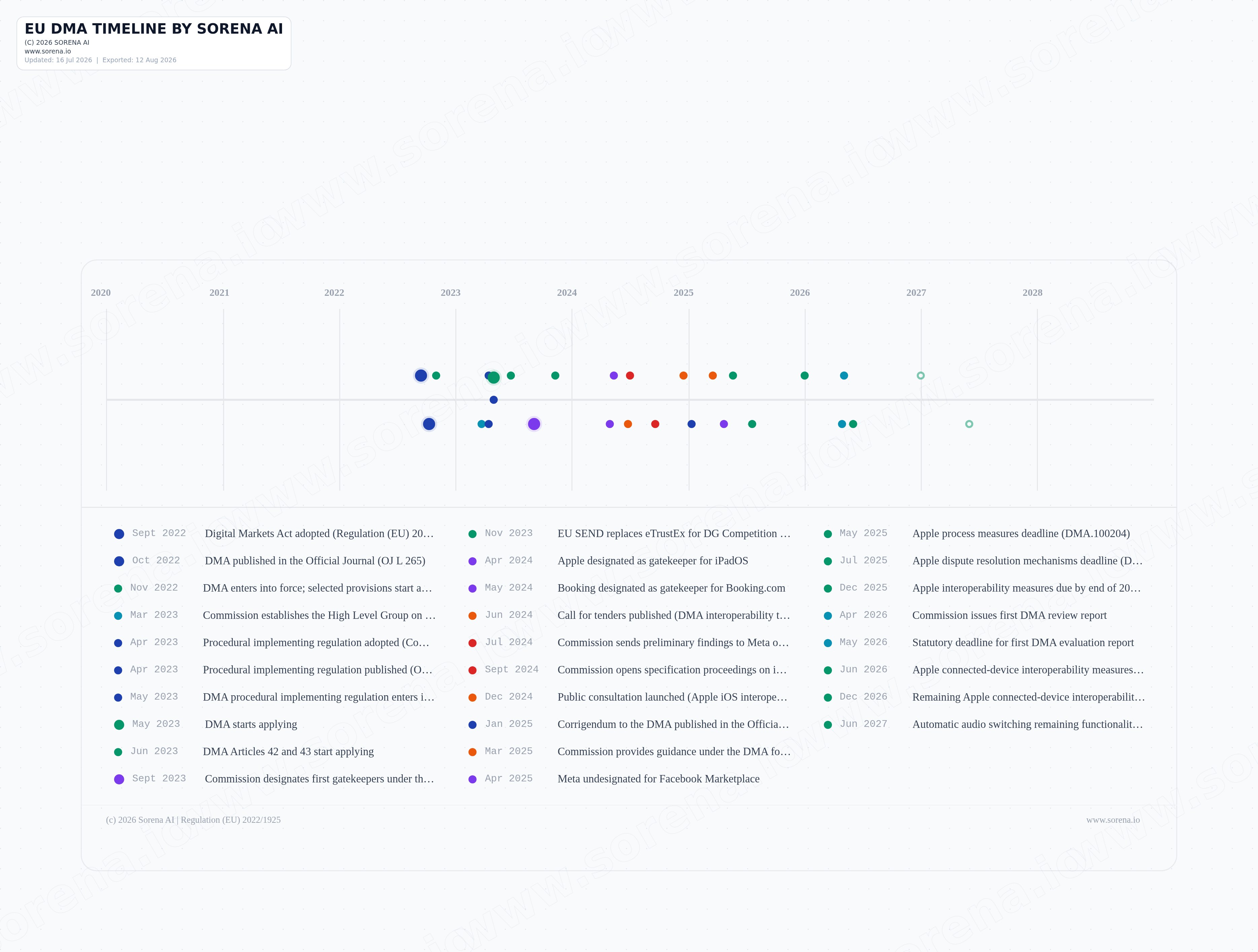
EU Digital Markets Act Gatekeepers, CPS, and Product Obligations
The DMA applies across the EU to undertakings designated by the European Commission as gatekeepers and to the core platform services listed in their designation decisions. This hub explains designation, service scope, Articles 5-7 duties, reporting, and enforcement.
A threshold result is not a designation decision, and a Commission specification decision is not a finding of non-compliance. Use the topic guides to identify the right legal stage before assigning product controls or evidence.
Regulation (EU) 2022/1925 has applied since 2 May 2023. Use the binding text and the relevant Commission decision for the legal position; the workflows and checklists here are Sorena review aids.
Key milestones for DMA designation and compliance
The DMA entered into force on 1 November 2022 and has applied since 2 May 2023. Track later service-specific designation decisions, six-month compliance windows, annual reporting updates, specification decisions, and enforcement milestones only where cited sources support them.
Choose the next DMA decision
New to the DMA? Start by confirming the undertaking, , thresholds, and designation status. If those decisions are already documented, jump to the obligation, evidence, deadline, enforcement, or comparison you need.
Start here: designation and service scope
Decide whether the service is a DMA core platform service, test the Article 3 criteria and quantitative presumptions, and prepare the service-specific designation record.
Obligations and product rules
Map Articles 5, 6, and 7 to the listed service, then examine the product areas where interoperability, data access, ranking, steering, defaults, and user choice become concrete.
Implementation and evidence
Turn the applicable obligations into owned controls, product-release gates, anti-circumvention review, monitoring, and an Article 11 evidence pack for each designated service.
Deadlines, reporting, and enforcement
Track event-driven notification and compliance clocks, annual reporting and audit work, Commission proceedings, remedies, fines, and periodic penalty payments without treating every date as universal.
Compare adjacent rules or answer a specific question
Separate DMA duties from the DSA, Data Act, GDPR, and EU competition law, or use the focused FAQ when you already know the question you need to resolve.
DMA exposure mapping and evidence work
This hub is the shared starting point for DMA scoping. Confirm whether the undertaking is already designated or near the Article 3 thresholds, identify each , and then assign Article 5, 6, 7, and 11 work to the product, data, ads, app-store, , reporting, and legal owners who can change the service.
- Start with one undertaking and one service boundary: category of , EU end-user count, EU business-user count, Member State coverage, turnover or market-value position, and current Commission designation status.
- For designated core platform services, map each Article 5, 6, and 7 obligation to concrete product behavior: consent flows, anti-steering terms, ranking, defaults, uninstall and app-store access, data portability, business-user data, advertising transparency, and .
- Build the Article 11 evidence pack by and obligation: implementation date, pre-change behavior, technical changes, user-interface changes, terms changes, consultations, tests, indicators, raw data availability, and non-confidential summary positions.
- Treat enforcement readiness as a product-control issue: the Commission can impose fines up to 10% of total worldwide turnover, up to 20% for the same or a similar Article 5, 6, or 7 infringement involving the same after a non-compliance decision in the preceding eight years, and periodic penalty payments up to 5% of average daily worldwide turnover per day.