EAADirective (EU) 2019/882

EU Accessibility Act Compliance Hub

This hub helps decide whether a product or consumer service is covered by the (Directive (EU) 2019/882) and map requirements to design, QA, and release work.

By Sorena AIBased on official EU sourcesNo signup required
Quick scan
EAA
Scope first
Products include consumer computer hardware and operating systems, self-service terminals, communications and audiovisual terminal equipment, and e-readers.
Consumer service checks
Services include electronic communications, access to audiovisual media services, listed transport-service elements, consumer banking, e-books, and e-commerce.
Evidence path
For products, prepare Annex IV technical documentation, the EU declaration of conformity, CE marking records, and five-year retention. For services, publish accessible conformity information, keep it while the service operates, monitor changes, and correct and report non-conformity. is the legal requirements map; a standard such as supports only the requirements and version it actually covers.

Review scope before release or procurement. The general application date was 28 June 2025, but pre-existing service contracts, products already used to provide services, and some self-service terminals can follow separate Article 32 transition rules. Member State law determines whether the optional terminal rule was adopted.

Key dates
28 Jun 2025
Application
Annex I
Requirements
Annex IV
Product file
EN 301 549
ICT standard
What this hub helps you decide
Is the offering in scope?
Check Article 2 against the actual product or service category, market date, consumer use, specific web and mobile content exclusions, the , and any Article 32 transition.
Who owns the obligation?
Separate manufacturer, authorised representative, importer, distributor, and service provider duties before assigning documentation, CE marking, customer information, and corrective-action work.
What evidence is needed?
Build a file that links requirements to design decisions, test results, standards used, technical documentation, service information, and any assessment.
Scope check
Annex I mapping
Evidence pack
Publication details
Editorial metadata for this artifact
Author
Sorena AI
Published
Feb 21, 2026
Updated
Jul 16, 2026

Validate product or service scope, the responsible operator, the 28 June 2025 application date, and the applicable requirements against both the Directive and the national law that implements and enforces it in each Member State where you operate.

EAA Timeline

Key dates for EU Accessibility Act planning

Track the transposition, application, and transition milestones that affect covered products, covered consumer services, and legacy self-service terminals.

Loading timeline...
Recommended reading path

Choose the next accessibility decision

New to the Act? Start by classifying the actual product or consumer service and assigning the operator role. If scope is already documented, jump to requirements, evidence, transitions, standards, enforcement, or a focused question.

1

Start here: scope, category, and role

Decide whether the offering matches an Article 2 category, which date and national implementation matter, and whether the organisation acts as manufacturer, authorised representative, importer, distributor, or service provider.

2

Requirements, exceptions, and enforcement

Map the applicable Annex I outcomes, separate the service-microenterprise exemption from Article 14, document any claimed limit, and understand the national enforcement framework.

3

Implementation, testing, and evidence

Turn applicable requirements into owned controls, version-specific tests, product or service records, supplier acceptance gates, and evidence that remains current after change.

EU Accessibility Act checklist for products and services
Checklist for EAA scope, operator role, Annex I mapping, product technical files, service information, Article 14 assessments, supplier evidence, release checks, and monitoring.
Read guide
EU Accessibility Act compliance operating model
Build an EU Accessibility Act compliance file for covered products and services: scope, operator roles, Annex I mapping, conformity evidence, Article 14 assessments, corrective actions, and records.
Read guide
EAA testing and conformance evidence | Annex I, EN 301 549 and Article 14
How to document European Accessibility Act testing evidence: Annex I mappings, product technical files, service information, EN 301 549 boundaries, harmonised-standard limits, and Article 14 exception records.
Read guide
EAA Accessibility Conformance Statement Template
Template language for an EU Accessibility Act conformance statement covering scope, Annex I mapping, service information, standards, support routes, evidence, and limits.
Read guide
EAA EN 301 549 clause mapping for ICT evidence
Map EN 301 549 clauses to EU Accessibility Act evidence, Annex I outcomes, product and service records, and gaps that need non-ICT support.
Read guide
EN 301 549 evidence matrix workflow for EAA readiness
Build an EN 301 549 evidence matrix for European Accessibility Act work: scope rows, clause mapping, test evidence, owner sign-off, exception records, and limits of standards evidence.
Read guide
EAA WCAG evidence and procurement acceptance
How to use EN 301 549 and WCAG evidence in EU Accessibility Act procurement acceptance without overstating presumption of conformity.
Read guide
EAA procurement clauses and accessibility acceptance criteria
Buyer-side EU Accessibility Act procurement language for covered products and services, with supplier evidence, EN 301 549 limits, Article 14 exception records, and acceptance criteria.
Read guide
4

Deadlines, transitions, and consumer journeys

Separate the general application date from the five-year limit for pre-existing service contracts, the 28 June 2030 service-equipment transition, any nationally adopted self-service-terminal useful-life rule, and emergency-communications timing, then apply the result to ecommerce and checkout delivery.

5

Standards, comparisons, and focused questions

Use EN 301 549 and WCAG without overstating legal coverage, keep other accessibility regimes separate, or go directly to the FAQ when the question is already known.

Next step

Turn EU Accessibility Act scope and evidence into owned implementation work

This hub helps route EAA work by product, service, operator role, and release path. Assessment Autopilot can convert the guidance into owners, evidence requests, and review checkpoints; Research Copilot can support cited scope or interpretation questions.

What this unlocks
  • Start with the product or service category, the market or service date, and the responsible economic operator.
  • Use Assessment Autopilot to request mappings, accessibility test evidence, product documentation, service information, and records where relevant.
  • Use Research Copilot for cited questions about Article 2 scope, service-provider information, product operator duties, standards mapping, and market surveillance evidence.
  • Keep design, engineering, QA, legal, procurement, and support records connected to the same cited accessibility evidence file.
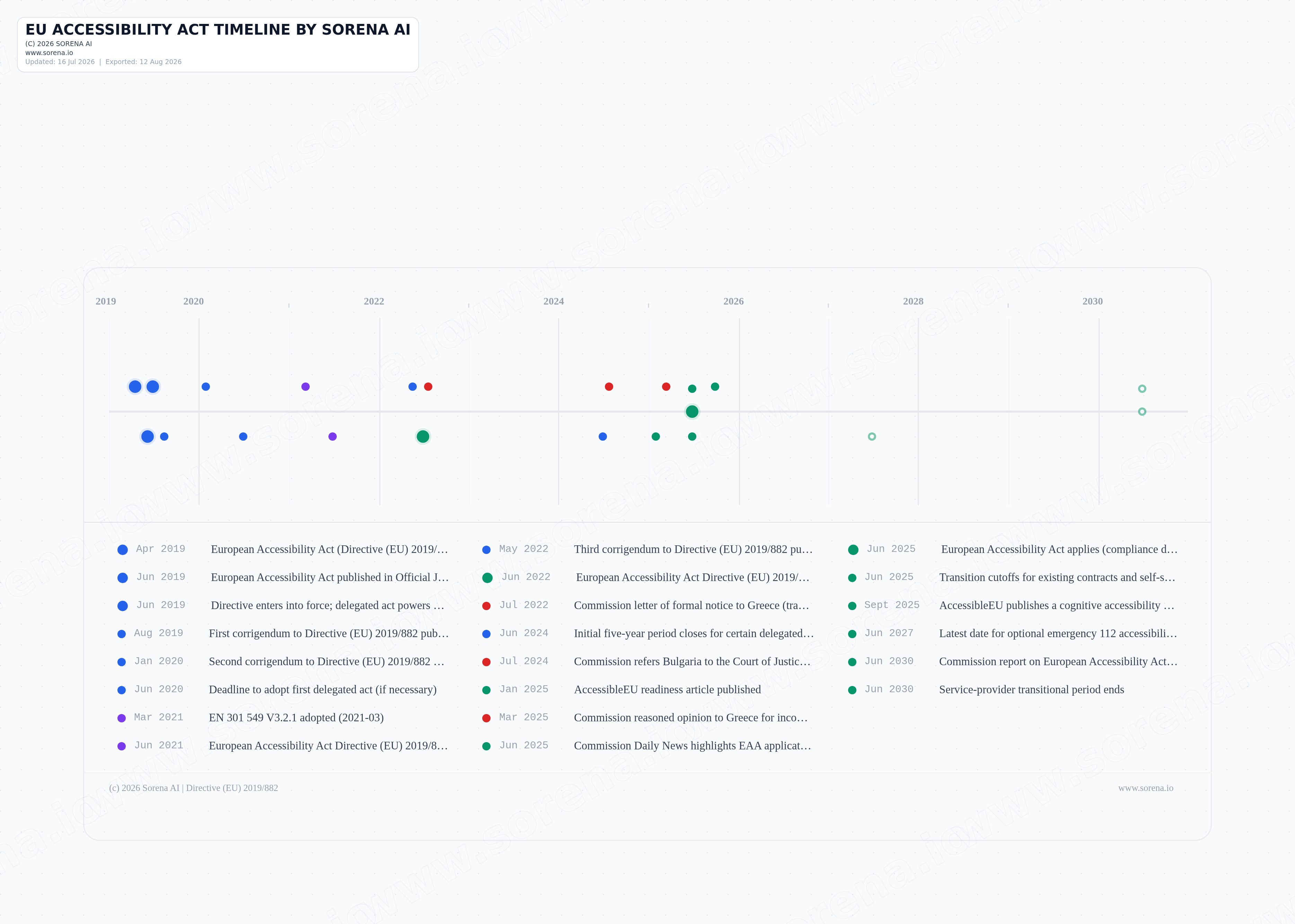
EU Accessibility Act artifact preview
Share it internally
Download the timeline export to align legal, product, engineering, and commercial teams on milestones and deadlines.