EU Taxonomy Timeline, Eligibility and Article 8 Guide
The EU Taxonomy classifies economic activities, not whole companies. Start by checking whether the undertaking must publish sustainability information under Article 19a or 29a of the Accounting Directive and therefore reports under Taxonomy Regulation . Then separate activity eligibility from alignment and disclosure.
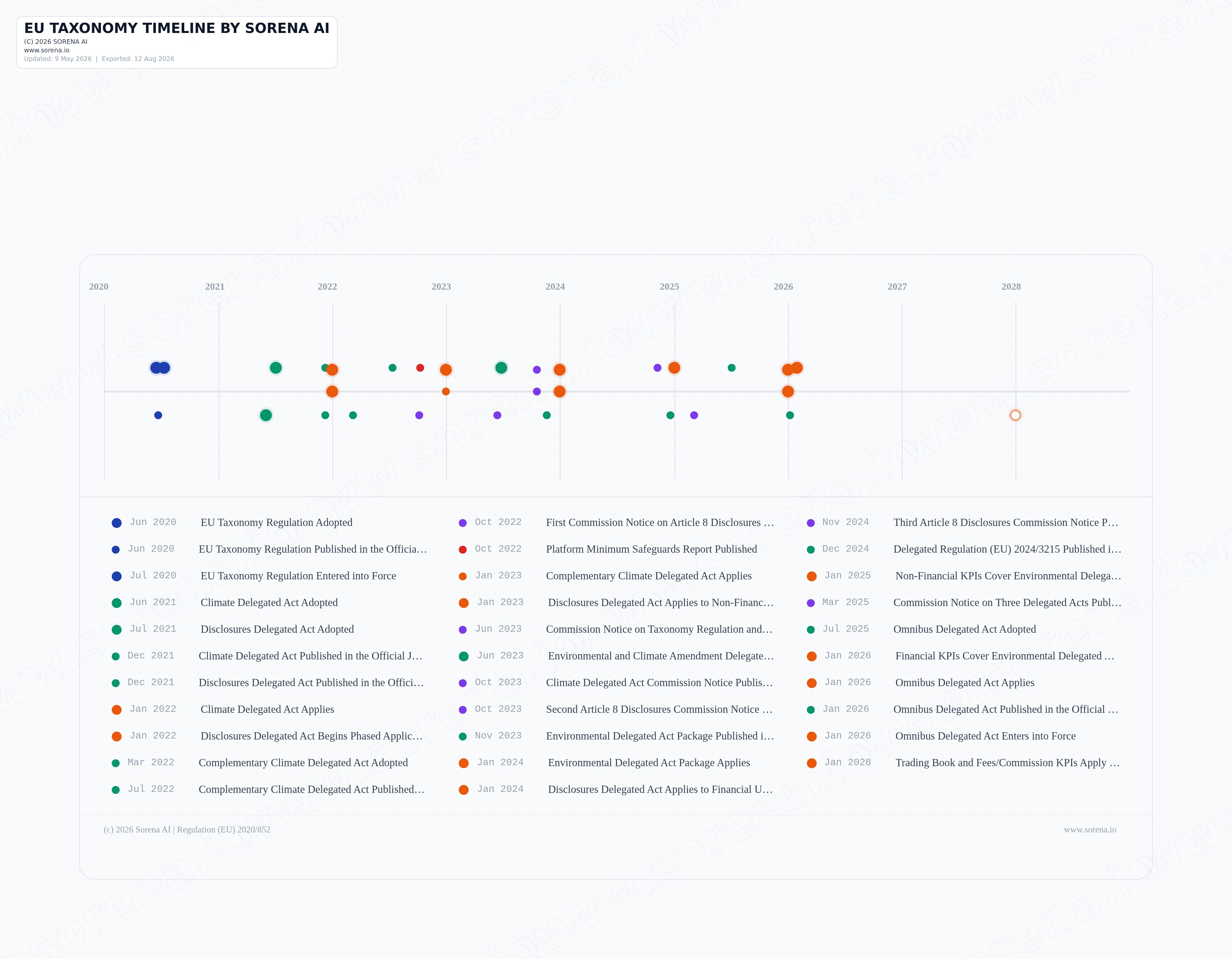
Use the visual timeline for legal changes, then follow the grouped guides from reporting scope to activity evidence and KPIs. Climate criteria applied from 1 January 2022; the Taxonomy Regulation's provisions for the other four objectives applied from 1 January 2023, and the Environmental Delegated Act criteria applied from January 2024. Regulation (EU) 2026/73 applies from 1 January 2026, subject to its 2025-financial-year option. Do not implement the March 2026 draft screening-criteria revisions unless an adopted act is published and applicable.
An is only covered by a delegated-act description. Calling it aligned requires substantial contribution to at least one of six objectives, no significant harm to the others, , and every applicable technical screening criterion. A company can therefore report a mix of non-eligible, eligible but not aligned, and aligned activities. Regulation (EU) 2026/73 applies from 1 January 2026, subject to its option to use the rules in force on 31 December 2025 for a financial year that started during 2025.
Key dates for delegated acts and disclosures
Track the core Regulation, Taxonomy delegated acts, disclosure rules, Commission notices, and amendments that change activity coverage or reporting evidence. Regulation (EU) 2026/73 applies from 1 January 2026, while the March 2026 climate and environmental screening-criteria revisions remain draft initiatives pending adoption and Official Journal publication.
Choose the next EU Taxonomy decision
New to the Taxonomy? Start with reporting scope and the difference between eligibility and alignment. If those decisions are documented, jump to criteria evidence, KPIs, change monitoring, or a comparison guide.
Start here: scope and classification
Identify the reporting undertaking and its KPI family, then learn why a covered economic activity is eligible but not necessarily aligned.
Eligibility, alignment, and criteria
Map the activity to an adopted delegated act and test substantial contribution, DNSH, minimum safeguards, and every applicable technical screening criterion.
Implementation and evidence
Turn the criteria decision into owned records, calculation controls, CapEx-plan evidence, review gates, and defensible public wording.
Article 8 disclosures and KPIs
Select the correct non-financial or financial-undertaking methodology and keep turnover, CapEx, OpEx, GAR, numerator, denominator, and qualitative disclosures traceable.
Dates, delegated acts, and change control
Use binding application dates for reporting, distinguish adopted amendments from proposals and guidance, and reassess affected activities and templates before publication.
Compare frameworks or answer a focused question
Understand how Taxonomy calculations interact with CSRD and SFDR without treating one framework as proof of compliance with another, or go directly to a focused FAQ.
Turn EU Taxonomy planning into an ESG delivery workflow
This overview is the shared starting point for Taxonomy work, then route live execution into ESG Compliance and source-specific research questions into Research Copilot.
- Route each activity through eligibility, alignment, , minimum-safeguards, and disclosure checks.
- Use ESG Compliance to assign activity owners, evidence owners, reviewer roles, and reporting tasks.
- Use Research Copilot when a delegated act, Commission notice, or activity boundary needs cited interpretation.
- Keep Taxonomy conclusions, source links, assumptions, and approval history together before reporting.