PPWRFree Resource

EU PPWR Packaging Scope, Duties and Timeline

This hub helps classify under Regulation (EU) 2025/40, then route the work into specifications, labels, conformity records and recyclability, recycled-content and evidence.

By Sorena AIBased on official EU sourcesUpdated July 2026
Quick scan
PPWR
Recyclability (Article 6)
assessment starts with grades A/B/C from 1 January 2030 or, if later, 24 months after the relevant delegated acts enter into force. assessment is added from 1 January 2035 or, if later, five years after the relevant implementing acts enter into force.
Materials (Articles 5-7)
Track substances of concern, food-contact restrictions from 12 August 2026, and minimum recycled-content duties for plastic .
Labelling (Articles 12-13)
Prepare for harmonised labels, digital marking specifications, and corresponding labels for waste receptacles.

Use the guide to identify obligations by type, then use the topic guides to build specs and evidence.

Key dates
11 Feb 2025
In force
12 Aug 2026
Applies
2030 or later
DfR criteria
2040
Higher targets
What this PPWR hub helps you decide
Scope and format
First decide whether the item performs a function or is integral to the product. Then separate sales, grouped, transport, e-commerce, reusable, contact-sensitive, and food-contact packaging before applying the relevant PPWR workstream.
Design and material changes
Identify redesign needs for recyclability grades, criteria, recycled content in plastic , restrictions, and packaging minimisation.
Operational evidence
Plan labels, QR or other digital carriers, waste-receptacle alignment, reuse or refill system records, supplier data, and technical documentation.
Role and territory
Separate manufacturer, importer and distributor checks from the Member-State-specific role used for registration, reporting, financing, online-marketplace verification and authorised-representative decisions.
Recyclability grades
PFAS limits
Labelling + digital marking
Publication details
Editorial metadata for this artifact
Author
Sorena AI
Published
Feb 21, 2026
Updated
Jul 31, 2026

The PPWR is Regulation (EU) 2025/40, a directly applicable EU regulation covering all , regardless of material, and all packaging waste. Start with one packaging unit and route to market. Manufacturer, importer and distributor duties concern product conformity and traceability. The separate test controls registration and extended producer responsibility in each Member State where packaging or packaged products are first made available, or where packaging is unpacked by a business that is not the end user.

Focused PPWR guidance

Go straight to the packaging decision

Start with substance restrictions, recyclability, minimisation, product scope, or duties under the EU and Packaging Waste Regulation (PPWR). Use the guide library below for other packaging workstreams.

Apply Article 5 substance rules

restricts hazardous substances in . It requires manufacturers to minimize substances of concern, caps the combined concentration of lead, cadmium, mercury, and hexavalent chromium at 100 milligrams per kilogram, and adds separate limits for food-contact packaging from 12 August 2026.

Read the Article 5 guide
Understand recyclability grades

requires to be recyclable. sets Grades A, B, and C at 95%, 80%, and 70% recyclable by weight. The market restriction begins on 1 January 2030 or 24 months after the relevant delegated acts enter into force, whichever is later. From 1 January 2038, Grade C can no longer be placed on the market, subject to Article 6 exceptions.

Review the recyclability grades

Document packaging minimisation

By 1 January 2030, requires manufacturers or importers to reduce weight and volume to the minimum needed for its function. Test the package against the performance criteria in , such as protection, logistics, information, and accessibility. Record the assessment in the technical documentation required by .

Open the Article 10 guide

Separate PPWR from RoHS

The PPWR governs . The Restriction of Hazardous Substances Directive (RoHS) governs specified substances in covered electrical and electronic equipment (EEE). A boxed laptop can trigger both, but the cardboard box belongs in the PPWR file and the laptop's materials belong in the RoHS file.

Compare PPWR and RoHS

Assign producer and EPR duties

Extended responsibility () makes the producer finance and organize specified waste-management duties. Identify the producer separately in each EU country, then connect registration, any authorized representative, reporting, fees, and scheme evidence without confusing the waste role with the packaging manufacturer's conformity duties.

Review producer and EPR duties
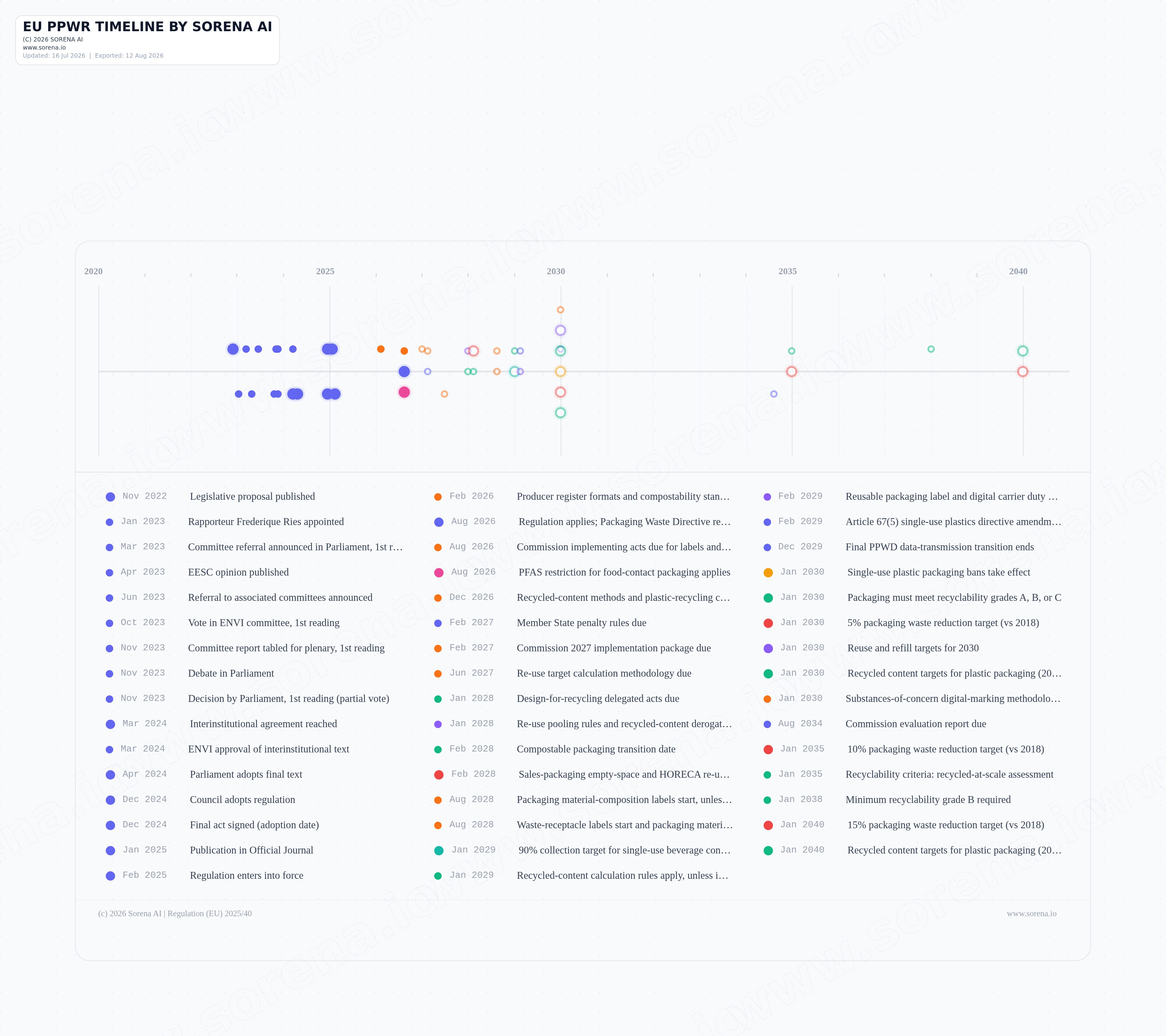
PPWR Timeline

Key dates for packaging compliance

Track entry into force, general application on 12 August 2026, and each rule-specific trigger. Several labelling, recyclability, recycled-content, reuse, and reporting dates use the later of a fixed date and a period after a Commission act enters into force, so the fixed date alone is not a release deadline. The timeline also covers 2030 and minimisation duties, the assessment from 2035 or later, and longer-range targets that affect redesign and supplier planning.

Loading timeline...
Recommended reading path

Choose the next PPWR packaging decision

New to PPWR? Start with one unit, its function, route to market and operator roles. If those decisions are documented, jump to the relevant design duty, evidence workflow, deadline or comparison.

1

Start here: scope, classification and roles

Decide whether the item is packaging, classify its function and material, identify how it reaches each Member State, and assign both product-conformity and EPR roles.

2

Packaging requirements and operator duties

Apply the relevant substance, recyclability, recycled-content, minimisation, reuse, labelling, conformity, EPR and enforcement rules to the classified packaging unit.

PPWR requirements overview for EU packaging teams
An official source overview of Regulation (EU) 2025/40 requirements for packaging scope, recyclability, recycled content, minimisation, labelling, reuse, EPR, and conformity evidence.
Read guide
PPWR Article 5 PFAS and Restricted Substances Guide
Official source guide to PPWR Article 5 substance controls: substances of concern, the 100 mg/kg heavy-metal cap, PFAS limits for food-contact packaging, and technical-documentation evidence.
Read guide
PPWR PFAS Rules for Food-Contact Packaging
Guide to PPWR Article 5 PFAS limits for food-contact packaging, including the 12 August 2026 date, thresholds, scope test, and evidence records.
Read guide
PPWR Recyclability and Design-for-Recycling Requirements
Article 6 PPWR guide to packaging recyclability grades, Annex II packaging categories, design-for-recycling parameters, recycled-at-scale assessment, and evidence files.
Read guide
PPWR Recycled Content Targets for Plastic Packaging
Article 7 PPWR targets for recycled content in plastic packaging, including 2030 and 2040 percentages, calculation basis, exclusions, and evidence records.
Read guide
PPWR Packaging Minimisation Guide: Article 10 Evidence
PPWR packaging minimisation guide covering Article 10, Annex IV evidence, protected-design exceptions, empty-space rules, and technical documentation.
Read guide
PPWR reuse and refill targets: Article 29 and take-away duties
Guide to PPWR reuse targets for transport, grouped, beverage, and take-away packaging, including Articles 29 to 33, reporting, and exemptions.
Read guide
PPWR labelling and consumer information requirements
Article 12 and Article 55 PPWR guidance for packaging labels, QR codes, online sales information, waste receptacle labels, and consumer information records.
Read guide
EU PPWR Conformity Documentation Guide
Build PPWR technical documentation and EU declarations of conformity for packaging, with evidence fields, owner checks, retention rules, and official EU sources.
Read guide
PPWR EPR and Producer Responsibility Guide
Map PPWR EPR duties for producers, authorised representatives, producer responsibility organisations, online platforms, registrations, reporting and evidence under Regulation (EU) 2025/40.
Read guide
EU PPWR penalties and fines: Article 68 enforcement guide
Official source guide to PPWR penalties and fines: Article 68 Member State rules, administrative fines for Articles 24 to 29, market-surveillance action, formal non-compliance, and enforcement evidence.
Read guide
3

Implementation and evidence

Turn the assigned duties into packaging specifications, supplier evidence, assessment records, artwork controls, reuse calculations and a maintained secondary-legislation watchlist.

PPWR compliance checklist for packaging teams
A cited PPWR checklist for packaging scope, recyclability, recycled content, PFAS, minimisation, labelling, conformity files, and EPR registration under Regulation (EU) 2025/40.
Read guide
PPWR compliance guide: packaging conformity, EPR and evidence
Build a PPWR compliance workflow for packaging placed on the EU market, covering Articles 5-12 controls, conformity assessment, technical files, declarations, labelling, EPR and evidence.
Read guide
PPWR Article 5 PFAS Evidence Workflow for Food-Contact Packaging
Build a PPWR Article 5 evidence workflow for food-contact packaging PFAS checks, limit-value evidence, supplier proof, and Annex VII technical documentation.
Read guide
PPWR recyclability grades A, B and C explained
Understand PPWR recyclability grades under Article 6 and Annex II, including design-for-recycling thresholds, 2030, 2035 and 2038 timing, and evidence records.
Read guide
PPWR Recyclability Assessment Workflow | Article 6 and Annex II
Assess PPWR recyclability by packaging unit: map the Annex II category, screen design-for-recycling parameters, grade the result, and retain Annex VII evidence.
Read guide
PPWR Recyclability Assessment Template
This PPWR recyclability assessment template helps record packaging category, DfR parameters, performance grade evidence, recycled-at-scale evidence, and approval owners.
Read guide
PPWR Article 12 labelling, QR codes, and digital carriers
Guide to PPWR Article 12 packaging labels, reusable packaging QR codes, digital carriers, online-sale information, exceptions, and evidence records.
Read guide
PPWR labelling rollout workflow for Article 12 and 13
Roll out PPWR Article 12 packaging labels, digital carriers, reusable-packaging information, and Article 13 waste-receptacle labels on the correct dates.
Read guide
PPWR labelling checklist for Articles 12 and 13
Checklist for PPWR Article 12 packaging labels and Article 13 waste-receptacle labels, including material composition, reuse, DRS, digital carriers, online sales, and transition stock.
Read guide
PPWR Articles 32 and 33 take-away refill and reusable offers
Guide to PPWR take-away duties: customer-owned container refill by 12 February 2027, reusable packaging offers by 12 February 2028, conditions, and exemptions.
Read guide
PPWR reuse target applicability workflow: Article 29 and 33
Decide whether PPWR Article 29 reuse targets, Article 32 refill duties, and Article 33 take-away reusable offers apply to a packaging flow.
Read guide
PPWR delegated and implementing act tracker
Track PPWR delegated and implementing acts for recyclability, recycled content, reuse, labelling, EPR, reporting, and evidence owners.
Read guide
5

Compare adjacent EU frameworks

Keep packaging duties separate from product ecodesign, chemicals, electrical-equipment substance controls, single-use plastics and the horizontal waste framework.

6

Answer a focused packaging question

Use the FAQ for direct answers on e-commerce, service, grouped, transport, compostable and reusable packaging, labelling dates, PFAS, recycled content and small-business edge cases.

Next step

Turn PPWR packaging decisions into owned implementation work

This hub is the shared entry point for PPWR scope, redesign, supplier, artwork, labelling, reuse, refill, and evidence work. Route confirmed duties into ESG Compliance and keep the supporting legal, product, supplier, and technical records in SSOT.

What this unlocks
  • Start with one unit, packaged product, channel, material, and operator role before assigning PPWR work.
  • Use ESG Compliance to manage recyclability, recycled-content, reuse, refill, minimisation, and reporting work across accountable owners.
  • Use SSOT to keep legal interpretation, technical documentation, supplier data, label records, test evidence, and approval history together.
  • Escalate delegated-act, implementing-act, exemption, or Member State questions against current official sources before release planning.
EU PPWR timeline and packaging implementation preview
Share it internally
Download the timeline export to align legal, product, engineering, and commercial teams on milestones and deadlines.