RoHSFree Resource

EU Restriction of Hazardous Substances (RoHS) Scope, Exemptions and Evidence Hub

Use this hub to decide whether an item is electrical and electronic equipment under Directive 2011/65/EU, apply the limits to each , and prepare the evidence needed before EU market placement. includes equipment that needs electric current or electromagnetic fields for at least one intended function and stays within the Directive's voltage limits.

By Sorena AIBased on official EU sourcesNo signup required
Quick scan
RoHS
Substances
lists 10 restricted substances. Cadmium is limited to 0.01% by weight in homogeneous materials; the other nine listed substance groups use 0.1%.
Exemptions
Article 5 exemptions are time-limited and reassessed; renewal applications are due no later than 18 months before expiry.
Evidence
is the cited harmonised technical-documentation standard. Its voluntary use can support presumption of conformity for the documentation requirement; it does not replace the underlying Article 4 substance assessment.

Review this hub before design freeze, supplier onboarding, exemption renewal review, product release, importer checks, distributor review, or market-surveillance response.

Key dates
2011/65/EU
Directive
10
Substances
EN IEC 63000:2018
Tech docs
18 months
Renewal lead
What this RoHS hub helps you decide
Scope and category
Check whether the marketed item needs electricity or electromagnetic fields for an intended function, is designed for no more than 1,000 V AC or 1,500 V DC, and fits one of the 11 categories. Then test every condition of any Article 2 exclusion or dated cable or spare-part rule.
Restricted substances
Map lead, mercury, cadmium, hexavalent chromium, PBB, PBDE, DEHP, BBP, DBP, and DIBP against the maximum concentration values in each , such as a plastic housing, copper wire, coating, alloy, or solder joint.
Exemptions
Match the exact Annex III or Annex IV wording to the substance, material, use, category, and date. A pending request for a new exemption does not permit market placement; a timely renewal request can keep an existing exemption valid until the Commission decides.
Release evidence
Manufacturers plan supplier declarations, material-risk review, method-appropriate IEC 62321 testing where needed, EN IEC 63000 technical documentation, internal production control, the , CE marking, change control, and 10-year retention. Importers and distributors perform their separate pre-market checks.
Homogeneous material
Exemption tracking
Supplier evidence
Publication details
Editorial metadata for this artifact
Author
Sorena AI
Published
Feb 21, 2026
Updated
Jul 25, 2026

Start with the marketed product and your manufacturer, importer, or distributor role. Then document any Article 2 exclusion, the category, each relied-on Annex III or IV entry, and the current conformity evidence. A is one uniform material, or a material combination that cannot be separated mechanically; the limits apply to each such material, not to the product average.

Focused RoHS guidance

Start with the RoHS evidence decision

Confirm scope under the EU Restriction of Hazardous Substances Directive (RoHS) and apply its material-level limits. Then build technical documentation from supplier evidence, targeted checks, exemptions, and controlled product records.

Review supplier declarations

A states what the supplier claims about a named part or material. Match it to the part number, material, supplier, restricted substances, claimed exemption, and document revision. For example, a declaration for a cable jacket does not prove that the connector, solder, and finished device comply.

Review RoHS supplier evidence
Build EN IEC 63000 technical documentation

EN IEC 63000 is the European standard for preparing RoHS technical documentation. Structure the file around product identity, materials and components, supplier information, test decisions, exemptions, the EU declaration of conformity, and change triggers. The standard explains how to build the evidence file; it does not certify every material as compliant.

Build the EN IEC 63000 evidence file

Apply limits by homogeneous material

means electrical and electronic equipment. Apply the RoHS limits to each , meaning one material that cannot be mechanically separated into different materials. Test solder, a plastic housing, and a cable coating separately; do not average them across the finished product. lists the restricted substances and maximum concentrations.

Review homogeneous-material thresholds

Check EEE scope and category

means electrical and electronic equipment that depends on electric current or electromagnetic fields to work, or equipment that generates, transfers, or measures them. An can remove a product from scope, such as certain military equipment or a large-scale fixed installation. groups covered products into ten named categories; is the catch-all for other EEE, such as a covered electronic product that fits none of Categories 1 to 10.

Check RoHS EEE scope
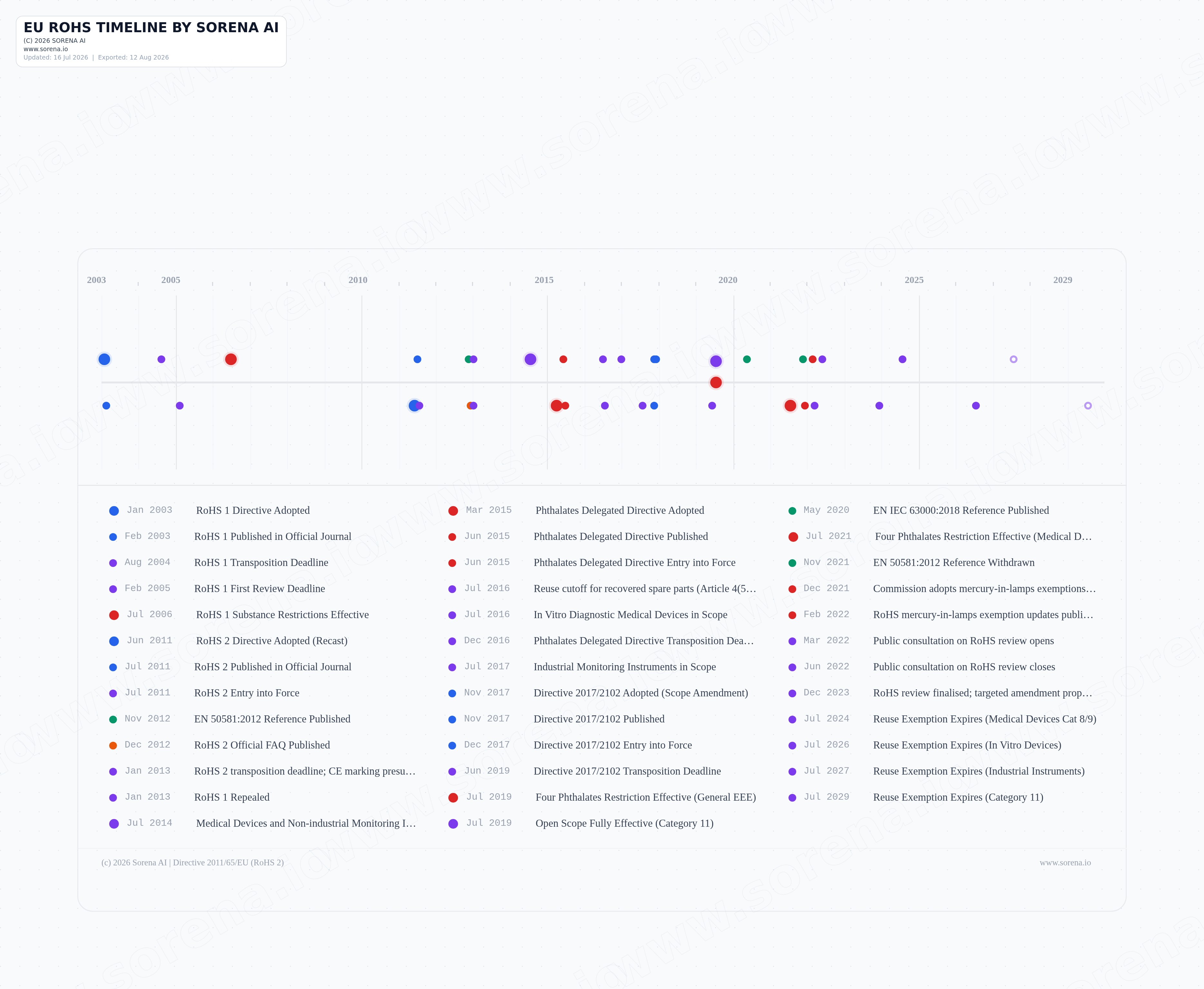
RoHS Timeline

Key dates for RoHS product-release planning

Separate historical scope and phthalate phase-ins from live controls. Other brought into open scope and the first general phthalate application date reached 22 July 2019; the phthalate restrictions reached medical devices and monitoring and control instruments on 22 July 2021. For a current release, use the latest consolidated Directive and delegated acts to verify Annex III and IV wording, category coverage, expiry, and renewal status.

Loading timeline...
Recommended reading path

Choose the next RoHS decision

If you are new to RoHS, start with product scope and economic-operator duties. Once those decisions are documented, go to the substance, exemption, evidence, deadline, enforcement, or comparison question that is blocking release.

1

Start here: scope, roles, and core duties

Decide whether the item is EEE, identify its Annex I category or exclusion, record the manufacturer, authorised representative, importer, or distributor role, and map the resulting RoHS duties.

2

Substances, thresholds, and special product cases

Apply Annex II at homogeneous-material level, then check phthalate timing, medical and monitoring equipment, cables, and spare-part rules against the exact product history.

3

Exemption decisions and lifecycle tracking

Match Annex III or IV wording to the product, material, use, category, and date, then govern renewal status and substitution planning without treating an exemption as a blanket waiver.

4

Implementation, supplier evidence, and CE records

Build the product evidence chain from BOM and supplier intake through risk-based verification, technical documentation, the EU declaration of conformity, CE marking, and change control.

EU RoHS compliance checklist for EEE
Checklist for EU RoHS scope, restricted substances, homogeneous materials, exemptions, CE marking, technical documentation, and supplier evidence.
Read guide
RoHS BOM evidence intake workflow
Build a RoHS BOM evidence intake process for EEE: map parts to homogeneous materials, collect supplier declarations, handle exemptions, and feed EN IEC 63000 technical documentation.
Read guide
RoHS Supplier Declarations Guide
Use RoHS supplier declarations as supporting evidence for BOM, material, exemption, and technical-file reviews without replacing manufacturer EU DoC or CE duties.
Read guide
RoHS Supplier Declarations and Verification Guide
Build a RoHS supplier evidence file without confusing supplier declarations with manufacturer EU DoC, CE marking, technical documentation, or importer checks.
Read guide
RoHS Supplier Declaration Template
Use a structured EU RoHS supplier declaration to collect material evidence, exemption claims, test records, and EN IEC 63000 technical-file inputs.
Read guide
RoHS Supplier Change Control Workflow
Control EU RoHS risk after part substitutions or material changes by reassessing supplier declarations, test needs, exemptions, and technical-file updates.
Read guide
RoHS Risk-Based Testing Guide
Choose proportionate EU RoHS verification using supplier evidence, EN IEC 63000 documentation, IEC 62321 methods, and product-specific risk decisions.
Read guide
EU RoHS test plan selection workflow
Choose RoHS supplier evidence, EN IEC 63000 technical documentation, and IEC 62321 testing without over-testing or under-documenting restricted substances.
Read guide
EN IEC 63000 RoHS Technical Documentation
Build EN IEC 63000:2018 technical documentation for EU RoHS with manufacturer duties, evidence selection, harmonised-standard context, and file maintenance.
Read guide
RoHS technical documentation, EU DoC and CE marking
Connect RoHS technical documentation and EN IEC 63000 evidence to the EU declaration of conformity, CE marking, and economic-operator duties.
Read guide
EU RoHS CE Marking and Declaration of Conformity
Understand RoHS CE marking, the EU Declaration of Conformity, EN IEC 63000 technical documentation, and importer or distributor checks.
Read guide
5

Dates, transitions, and enforcement

Separate historical phase-ins from live product controls, track exemption and reused-spare-part cutoffs, and assess national penalty exposure and market-surveillance response duties.

6

Compare adjacent regimes or answer a focused question

Keep RoHS evidence distinct from REACH, POPs, Batteries, WEEE, LVD, and EMC work, or use the FAQ when a narrow scope, cable, component, threshold, declaration, exemption, or spare-part question is already known.

RoHS, REACH, POPs, and batteries overlap
Separate RoHS restrictions and evidence from REACH, POPs, Batteries Regulation, waste, and adjacent technical-file workstreams for the same product.
Read guide
RoHS vs REACH for electronics: scope, evidence, overlap
Compare EU RoHS and REACH for electrical and electronic equipment: scope, restricted substances, evidence, CE marking, exemptions, and overlap decisions.
Read guide
RoHS vs POPs for EEE substance compliance
Compare EU RoHS and POPs obligations for electrical and electronic equipment: scope, substances, evidence, CE files, exemptions, waste overlap, and cited decision rules.
Read guide
RoHS vs Batteries Regulation scope comparison
RoHS-focused comparison explaining when RoHS applies to EEE, why batteries sit outside RoHS, and what evidence should not be reused without separate battery-law support.
Read guide
RoHS vs WEEE: EU electronics compliance comparison
Compare EU RoHS restricted-substance duties with WEEE end-of-life recycling obligations, with RoHS scope, evidence, CE marking, exemptions, and cited decision points.
Read guide
RoHS vs LVD/EMC CE evidence: what belongs in the RoHS file
Compare RoHS substance evidence with separate LVD and EMC CE evidence streams across scope, technical files, declarations, CE marking, exemptions, and supplier records.
Read guide
EU RoHS Directive FAQ: scope, substances, CE marking
Practical EU RoHS Directive FAQ covering EEE scope, Annex II substance limits, cables, spare parts, technical documentation, CE marking, and exemptions.
Read guide
Next step

Turn RoHS scope, substances, exemptions, and evidence into owned release work

This hub is the shared entry point for RoHS product classification, substance checks, exemption reliance, supplier evidence, test planning, technical documentation, , CE marking, and importer or distributor review.

What this unlocks
  • Start with the product boundary, category, intended market placement, economic-operator role, substance-risk materials, and any claimed Annex III or IV exemption.
  • Use Assessment Autopilot to request supplier declarations, material declarations, BOM risk review, targeted IEC 62321 testing, exemption rationale, expiry monitoring, technical documentation, , and CE marking checks.
  • Use SSOT to keep product facts, supplier records, substance evidence, test reports, exemption decisions, standards references, release approvals, and market-surveillance responses connected to one governed product file.
  • Keep exemption renewal timing visible so procurement and engineering are not relying on an expired or narrowed exemption during a product release.
EU RoHS restricted substances, exemptions, and evidence preview
Share it internally
Download the timeline export to align legal, product, engineering, and commercial teams on milestones and deadlines.