EUDRFree Resource

EU Deforestation Regulation Scope, due diligence and rollout

Use this artifact to decide whether a product line is caught by the EUDR, which role applies in the supply chain, and what evidence must exist before the product is placed or made available on the EU market or exported.

Regulation (EU) 2023/1115 covers relevant commodities and Annex I derived products linked to cattle, cocoa, coffee, oil palm, rubber, soya and wood. The core gate is simple: covered products must be deforestation-free, produced in accordance with the relevant legislation of the country of production, and covered by the required due diligence statement or simplified declaration.

Review EUDR readiness
Publication details
Editorial metadata for this artifact
Author
Sorena AI
Published
Feb 22, 2026
Updated
Feb 23, 2026
What this EUDR hub helps you check
Commodity and product scope
Start with the seven relevant commodity groups, then confirm whether the exact derived product is listed in Annex I before asking suppliers for plot-level evidence.
Supply-chain role
Separate operators, downstream operators, traders, non-SME actors, and micro or small primary operators because the filing, information-system and recordkeeping duties differ.
Evidence before release
Link due diligence statements, declaration identifiers, supplier information, geolocation, country-risk status, risk assessment and mitigation records to the same shipment or product batch.
By Sorena AIGrounded in official EU sourcesNo signup required
Quick scan
EUDR
Classify the product
Check whether the product contains, was fed with, or was made using cattle, cocoa, coffee, oil palm, rubber, soya or wood, then confirm Annex I coverage.
Prove the Article 3 gate
Operators need enough information to show the product is deforestation-free, legally produced in the country of production, and covered by the required statement or declaration.
Prepare traceability records
Collect supplier and downstream-recipient details, reference numbers or declaration identifiers, and geolocation or allowed replacement data so records can be provided to competent authorities on request.
Use the timeline and topic guides to align sourcing, trade, legal, customs, ESG and supplier teams before release decisions depend on missing plot, role or statement data.
7
Commodity groups
30 Dec 2026
Core obligations
30 Jun 2027
Later micro/small date
5 years
Key records
Annex I scope
Geolocation data
Due diligence statements
EUDR Timeline

Key dates for EUDR scope, systems and phasing

Track the application dates, information-system readiness, country benchmarking and timber-transition milestones that affect when teams must be able to file statements, keep records and prove product-level traceability.

Loading timeline...

Topic guides

Deep dive pages for implementation planning, controls, reporting, and evidence.

1
EU Deforestation Regulation FAQ
Concise EU Deforestation Regulation answers on scope, covered commodities, operator and trader roles, due diligence statements, geolocation, low-risk countries, customs release, SME timing, enforcement, and records.
Read Guide
2
EUDR Applicability Test: Products, EU Market Activity, and Actor Roles
Test whether the EU Deforestation Regulation applies by checking Annex I product scope, EU market placement or export, operator/trader status, downstream role, SME status, and simplified due diligence conditions.
Read Guide
3
EUDR compliance checklist for products, suppliers, and DDS filing
A practical EU Deforestation Regulation checklist covering product scope, supplier evidence, geolocation, risk assessment, mitigation, due diligence statements, recordkeeping, and customs readiness.
Read Guide
4
EUDR compliance obligations for operators and traders
Source-grounded EUDR compliance guide covering operator and trader duties, Article 9 information, Article 10 risk assessment, Article 11 mitigation, due diligence statements, records, and authority-readiness.
Read Guide
5
EUDR country benchmarking and simplified due diligence
How EUDR country-risk benchmarking affects low-risk simplified due diligence, full due diligence, information collection, risk monitoring, and evidence records.
Read Guide
6
EUDR country benchmarking triage workflow
Route EUDR consignments and suppliers after country benchmarking: low-risk simplification checks, standard or high-risk due diligence, monitoring triggers, and evidence records.
Read Guide
7
EUDR deadlines and compliance calendar
A grounded EUDR calendar covering application dates, benchmarking milestones, the due diligence statement system, and preparation tasks for operators and traders.
Read Guide
8
EUDR deadlines, phasing, and first actions
Source-grounded EUDR readiness guide covering application dates, operator and trader first actions, geolocation evidence, due diligence statements, the information system, and country benchmarking.
Read Guide
9
EUDR Due Diligence Statement Evidence: DDS records, geolocation, and supplier proof
Build an EUDR evidence file for due diligence statements: Article 9 information, geolocation records, supplier proof, risk assessment, mitigation, reference numbers, and retention.
Read Guide
10
EUDR due diligence statement filing workflow
A grounded workflow for filing EUDR due diligence statements: prerequisites, Article 33 information-system use, reference numbers, role handoffs, and records.
Read Guide
11
EUDR Due Diligence Statement Template
A source-grounded EUDR due diligence statement template covering operator data, product scope, geolocation evidence, risk conclusion, reference numbers, and attachment records.
Read Guide
12
EUDR Geolocation Data Requirements: plots, suppliers, and DDS evidence
How to collect, check, and use EUDR geolocation evidence for relevant commodities and products, Article 9 information, risk assessment, supplier records, and due diligence statements.
Read Guide
13
EUDR Geolocation Evidence and Annex I Commodity Lookup
Build an EUDR evidence file that links Annex I commodity scope, supplier and trader records, geolocation evidence, product lots, risk assessment, and due diligence statement support.
Read Guide
14
EUDR Geolocation Traceability Systems: records, DDS handoffs, and supplier evidence
How to structure EUDR traceability records for geolocation, supplier evidence, product lots, risk assessment inputs, and due diligence statement handoffs.
Read Guide
15
EUDR in-scope commodities and products
How to check EUDR scope for the seven commodities, Annex I relevant products, operator and trader roles, and the evidence needed to support a scope decision.
Read Guide
16
EUDR Penalties and Enforcement: Checks, Corrective Action, and Sanctions
Grounded guide to EUDR enforcement: competent authority checks, interim measures, corrective action, EU penalty categories, and records to keep ready.
Read Guide
17
EUDR Penalties, Fines, and Enforcement Consequences
Grounded guide to EUDR enforcement exposure: Member State penalties, competent authority checks, corrective measures, product holds, and evidence records without invented national fine tables.
Read Guide
18
EUDR requirements for operators, traders, and DDS filing
Source-grounded guide to EU Deforestation Regulation requirements: scope, due diligence, geolocation, risk assessment, mitigation, DDS filing, records, and simplified regimes.
Read Guide
19
EUDR risk assessment and mitigation under Articles 10 and 11
How to run an EUDR Article 10 risk assessment, decide when risk is not negligible, apply Article 11 mitigation, and keep release evidence before placing products on the EU market or exporting.
Read Guide
20
EUDR Supplier Onboarding Template
A practical EUDR supplier onboarding template for Annex I product scope, supplier roles, geolocation evidence, risk inputs, mitigation records, DDS references, and five-year records.
Read Guide
21
EUDR vs CSDDD: product due diligence vs corporate due diligence
Compare EUDR product-level deforestation controls with high-level corporate due-diligence workstreams, focusing on scope, actors, due diligence statements, geolocation, country benchmarking, and evidence.
Read Guide
Next step

Turn EUDR scope and traceability into owned work

Use this EUDR hub as the shared entry point for product classification, supplier requests, geolocation collection, due diligence statement filing, risk assessment, mitigation, and record retention.

What this unlocks
  • Start with commodity group, Annex I product match, country of production, plot or establishment data, supplier, importer/exporter route, and EU role.
  • Use ESG Compliance to assign supplier onboarding, country-risk checks, risk assessment, mitigation and release-blocker reviews to accountable owners.
  • Use SSOT to keep due diligence statements, simplified declaration identifiers, geolocation evidence, supplier records, downstream-recipient records and competent-authority correspondence together.
  • Escalate non-negligible risk, missing geolocation, unclear Annex I coverage, mixed-origin lots, or outdated benchmarking assumptions before product release.
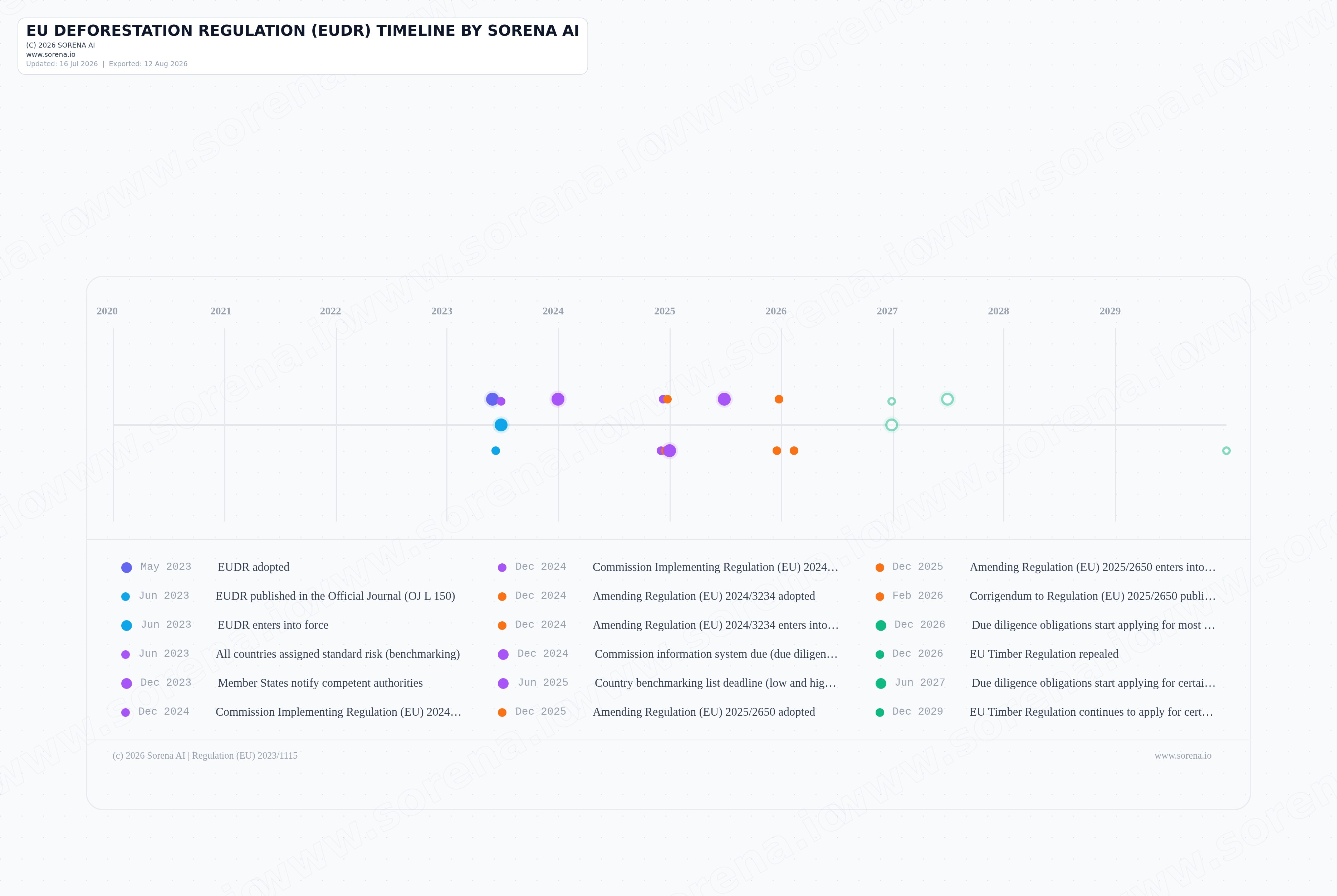
EU Deforestation Regulation artifact preview
Share it internally
Download the timeline export to align legal, product, engineering, and commercial teams on milestones and deadlines.