EU Batteries Regulation Scope, duties and rollout
Classify a battery under the EU Batteries Regulation (Regulation (EU) 2023/1542), then map the duties that apply when it is placed on the EU market or put into service and across its later lifecycle.
Use the timeline and grouped guides in order: category, operator role, applicable obligations, start date, evidence owner, then post-market and waste responsibilities.
Start with the battery category and your role. Then separate product-conformity duties from producer-responsibility, waste, passport, sustainability and supply-chain duties. Several obligations use category thresholds or depend on later Commission acts; for example, the Article 13 general-label date is 18 August 2026 or 18 months after the relevant implementing act enters into force, whichever is later.
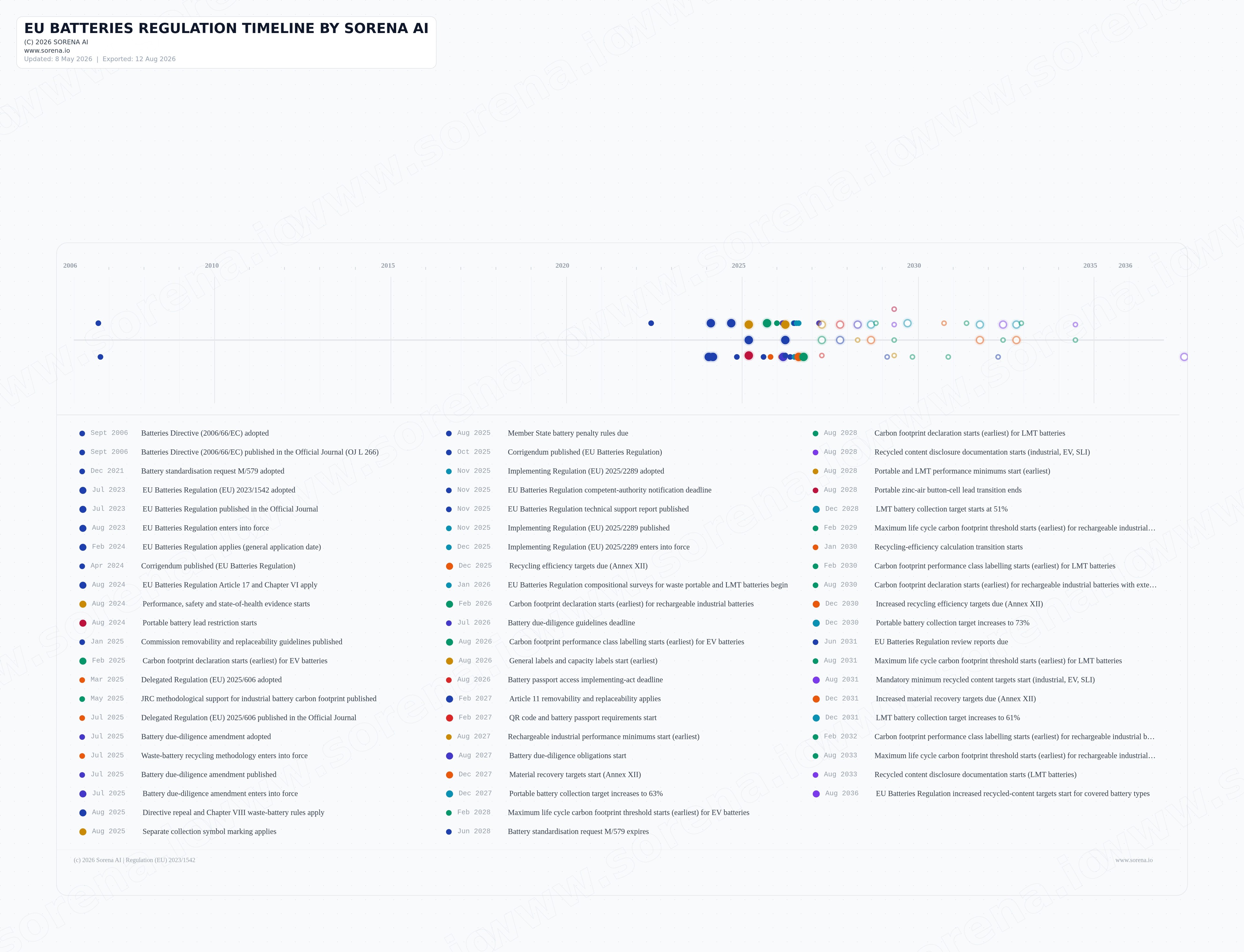
Key dates for battery categories and duties
Track the staged dates for application, state-of-health data, Chapter VI conformity rules, penalties, Chapter VIII waste duties, labels, QR codes, battery passports, removability, collection targets, recycling efficiency, material recovery, and recycled-content rules. Treat 18 August 2026 as the earliest general-label date because Article 13 uses a whichever-is-later condition tied to an implementing act.
Choose the next Batteries Regulation decision
New to the Regulation? Start with category and operator role. If those decisions are documented, jump to product evidence, sustainability and supply-chain duties, digital information, waste responsibilities, or the date you need to plan.
Start here: scope, category, and role
Decide whether the battery is in scope, route it to portable, LMT, SLI, EV, or industrial, and record the manufacturer, importer, distributor, producer, or other role that owns each duty.
Product conformity and design
Build the category-specific technical file, choose the conformity route, release the CE marking and labels, and address removability or replaceability where Article 11 applies.
Sustainability and supply-chain evidence
Separate carbon-footprint and recycled-content calculations from the Chapter VII due-diligence program, including the amended 18 August 2027 start date for in-scope operators.
Battery passport and digital information
Map Article 77 and Annex XIII data, access rights, provenance, QR-code resolution, lifecycle updates, and the distinction between a battery passport and the broader ESPR DPP framework.
Waste, deadlines, and enforcement
Plan producer registration, take-back, collection, recycling and reporting by Member State, then connect those controls to the phased legal dates and national penalty exposure.
Compare regimes or answer a focused question
Use the comparison when Batteries Regulation and ESPR work overlap, or open the FAQ when you already know the scope, label, passport, due-diligence, conformity, or waste question to resolve.
Turn EU Batteries Regulation scope and duties into owned work
This hub is the shared entry point for product, sustainability, supply-chain, regulatory, and waste-battery work. Route confirmed duties into ESG Compliance and keep the supporting product, supplier, conformity, passport, and recycling evidence in SSOT.
- Start with the battery category, chemistry, capacity, use case, placing-on-the-market path, and responsible economic operator.
- Use ESG Compliance to assign carbon-footprint, recycled-content, due-diligence, collection, recycling, and reporting work to accountable owners.
- Use SSOT to keep technical documentation, EU declarations of conformity, label records, QR destinations, passport data, supplier evidence, and recycler reports together.
- Escalate due-diligence timing and amendment questions against the current consolidated legal text before release planning.