EU AI ActFree Resource

EU AI Act Timeline, Decision Flow & Guides

Use this artifact to classify whether your AI system or model is prohibited, high risk, transparency triggered, or covered by GPAI duties, then turn that answer into a practical compliance plan grounded in Regulation (EU) 2024/1689.

The phased dates matter: the Regulation entered into force on 1 August 2024, prohibited practices and AI literacy apply from 2 February 2025, GPAI obligations apply from 2 August 2025, and most remaining rules apply from 2 August 2026, with later transition dates for certain cases.

Get an AI Act readiness review
Publication details
Editorial metadata for this artifact
Author
Sorena AI
Published
Mar 4, 2026
Updated
Mar 4, 2026
What you can decide faster
Scope and role
Decide whether the output used in the Union brings the system into scope and who is provider, deployer, importer, or authorised representative.
Risk and obligations
Separate Article 5 stop issues from Annex III high risk work, Article 50 disclosures, and GPAI provider duties.
Evidence path
Move from classification to documentation, release gates, supplier asks, and post market monitoring.
By Sorena AIUpdated 2026No signup required
Quick scan
AI Act
Phased dates
Track the 2025, 2026, 2027, and 2030 milestones that change what must be operational.
Decision flow
Classify prohibited practices, high risk status, transparency duties, and GPAI exposure.
Implementation guides
Use page specific guidance for applicability, high risk evidence, transparency, GPAI, and penalties.
Use the decision flow first, then use the linked guides to assign owners, evidence, and review dates.
1 Aug 2024
Entered force
2 Feb 2025
Early duties
2 Aug 2025
GPAI live
2 Aug 2026
Main date
Classify scope
Check Article 5
Plan evidence
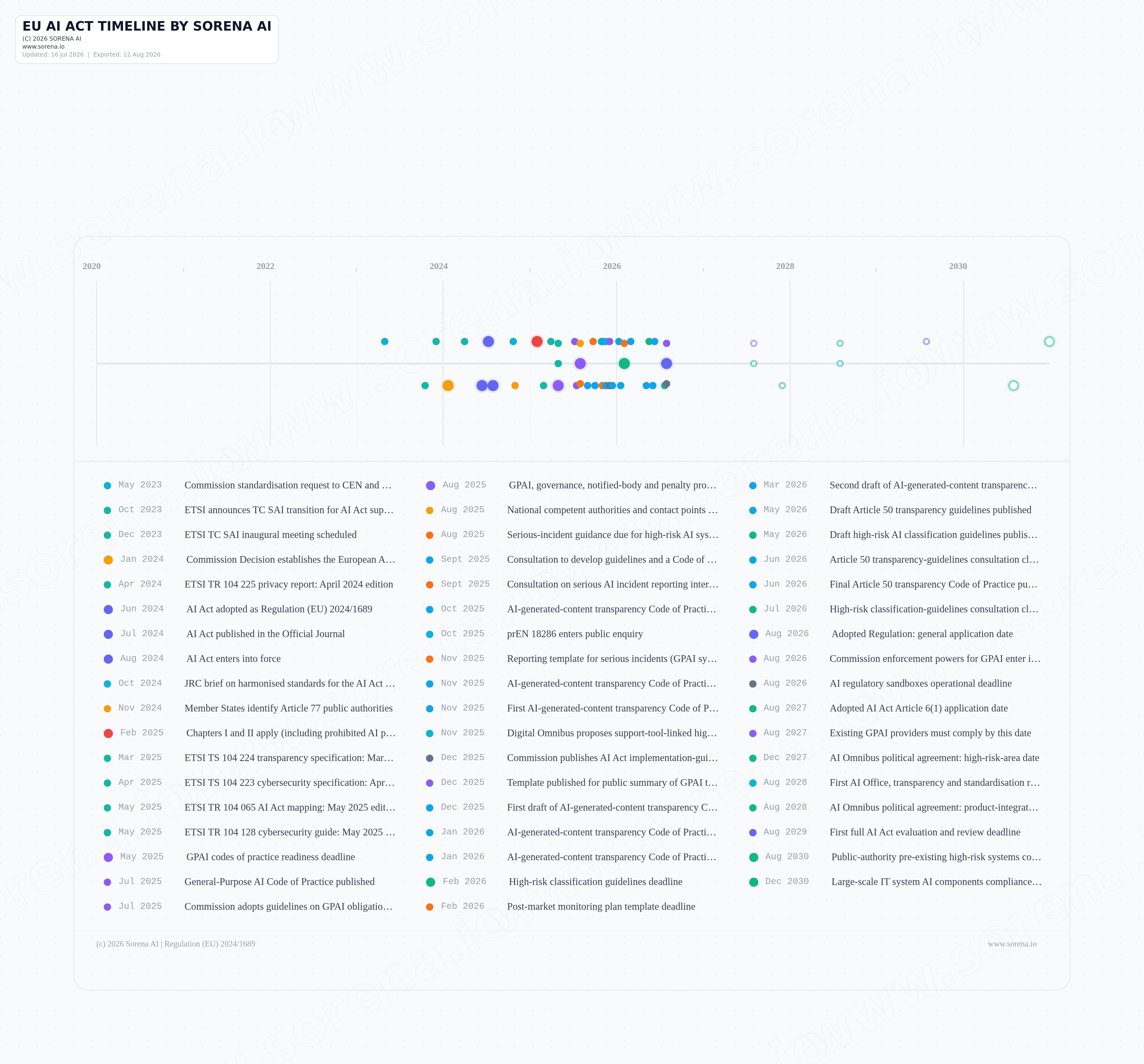
AI Act Timeline

Key dates for EU AI Act implementation

Track the legal phases so inventory, Article 5 screening, Chapter V work, high risk controls, and transition cases are sequenced correctly.

Loading timeline...
AI Act Decision Flow

Which AI Act duties apply to your system or model

Use the decision flow to route the system into the right obligation track, then open the supporting guides for detailed implementation.

Loading decision map...

Topic guides

Deep dive pages for implementation planning, controls, reporting, and evidence.

1
EU AI Act Applicability and Roles | Provider, Deployer, Importer Guide
Determine whether the EU AI Act applies, when output used in the Union brings a system into scope, and how to assign provider, deployer, importer.
Read Guide
2
EU AI Act Applicability Test | Scope, Role, and Obligation Routing
Run a practical EU AI Act applicability test that checks scope, exclusions, operator role, prohibited practices, high risk status, transparency triggers.
Read Guide
3
EU AI Act Checklist | Practical Compliance Checklist by Obligation
Use a detailed EU AI Act checklist covering inventory, role mapping, Article 5 screening, high risk controls, Article 50 disclosures, GPAI evidence, logging.
Read Guide
4
EU AI Act Compliance Program | Build an Operational AI Act Program
Build an EU AI Act compliance program that covers inventory, governance, AI literacy, prohibited practice gates, high risk controls, Article 50 product work.
Read Guide
5
EU AI Act Deadlines and Compliance Calendar | Exact Dates and Workplan
Track the exact EU AI Act dates, including entry into force on 1 August 2024, early obligations from 2 February 2025, GPAI obligations from 2 August 2025.
Read Guide
6
EU AI Act FAQ | Dates, High Risk, GPAI, Transparency, and Penalties
Get grounded answers to common EU AI Act questions on application dates, high risk status, provider versus deployer roles, transparency.
Read Guide
7
EU AI Act GPAI and Foundation Model Obligations | Chapter V Guide
Understand EU AI Act obligations for general purpose AI model providers, including Article 53 documentation, copyright policy.
Read Guide
8
EU AI Act High Risk AI Use Cases by Industry | Annex III and Product Routes
See how EU AI Act high risk status appears across biometrics, critical infrastructure, education, employment, essential services, law enforcement, migration.
Read Guide
9
EU AI Act High Risk Requirements Checklist | Articles 9 to 15 and Beyond
Use a detailed high risk AI checklist covering Article 9 risk management, Article 10 data governance, Annex IV technical documentation, logging, instructions.
Read Guide
10
EU AI Act Penalties and Fines | Article 99 and GPAI Fine Exposure
Understand EU AI Act penalty tiers, including Article 5 fines up to EUR 35,000,000 or 7 percent.
Read Guide
11
EU AI Act Prohibited AI Practices | Article 5 Screening Guide
Screen AI systems against EU AI Act Article 5 prohibited practices, including manipulative and deceptive techniques, exploitation of vulnerabilities.
Read Guide
12
EU AI Act Requirements | Prohibited, High Risk, Transparency, and GPAI
Get a grounded overview of EU AI Act requirements across Article 5 prohibited practices, Article 6 and Annex III high risk systems.
Read Guide
13
EU AI Act Timeline and Phasing Roadmap | Practical Implementation Roadmap
Follow a practical EU AI Act roadmap that aligns workstreams to the phased application dates for prohibited practices, AI literacy, GPAI obligations.
Read Guide
14
EU AI Act Transparency, Labeling, and User Disclosures | Article 50 Guide
Implement EU AI Act Article 50 transparency duties for direct interaction notices, machine readable marking of synthetic outputs, deepfake disclosures.
Read Guide
15
EU AI Act vs ISO 42001 | What ISO 42001 Covers and What It Does Not
Compare the EU AI Act with ISO/IEC 42001:2023. Learn where ISO 42001 helps with AI policy, roles, risk assessment, impact assessment, documented information.
Read Guide
16
EU AI Act vs NIST AI RMF | How to Use AI RMF Without Missing AI Act Duties
Compare the EU AI Act with NIST AI RMF 1.0. Learn how the voluntary NIST AI RMF functions Govern, Map, Measure.
Read Guide
Next step

Turn EU AI Act Timeline, Decision Flow & Guides into an operational assessment workflow

EU AI Act Timeline, Decision Flow & Guides should be the shared entry point for your team. Route execution into Assessment Autopilot for live work and into Research Copilot when the artifact needs deeper research, evidence governance, or supporting analysis.

What this unlocks
  • Start from EU AI Act Timeline, Decision Flow & Guides and route the work by entity, product, team, or control owner.
  • Use Assessment Autopilot to turn the guidance into owned tasks, evidence requests, and review checkpoints.
  • Use Research Copilot to answer scope, timing, and interpretation questions with cited outputs.
  • Move from artifact reading to accountable execution without rebuilding the guidance in separate files.
EU AI Act artifact preview
Share it internally
Download the artifact exports to align legal, product, engineering, and commercial teams.