EU CSRDFree Resource

EU CSRD Scope, ESRS reporting and assurance guide

This hub explains the CSRD as amended through Directive (EU) 2026/470: who reports, when the revised scope applies, what ESRS requires, and which evidence supports assurance.

By Sorena AIUpdated 2026No signup required
Quick scan
CSRD
Scope first
Confirm whether the undertaking exceeds the current CSRD scope thresholds, then document the group boundary, exemptions, financial-year trigger, and any third-country reporting route.
Materiality to datapoints
Run double materiality, identify impacts, risks, and opportunities, and map them to ESRS disclosures and datapoints instead of drafting from generic topic headings.
Evidence before publication
Keep calculation files, source-system extracts, supplier or estimate methods, taxonomy KPI support, assurance requests, and tagging decisions tied to each disclosure.

Follow the grouped guides in order: current scope and status, ESRS reporting decisions, implementation evidence, deadlines and assurance, then framework comparisons.

Key dates
ESRS
Standards
DMA
Materiality
Article 8
Taxonomy
XBRL
Digital
What this CSRD hub helps you confirm
Reporting scope and purpose
Separate the entity or group reporting boundary from the sustainability matters reported. Directive (EU) 2026/470 narrows the main Articles 19a and 29a scope from financial years beginning in 2027, so earlier CSRD size tests are not a current-scope shortcut.
ESRS disclosure model
Use ESRS 1, ESRS 2, topical ESRS, EFRAG materiality guidance, and the ESRS datapoint list to connect IROs, policies, actions, targets, metrics, and narrative disclosures.
Assurance and filing evidence
Prepare records that show materiality judgments, value-chain methods and cap decisions, data lineage, Article 8 Taxonomy inputs, digital-tagging decisions, and review sign-offs before the report is assured.
Double materiality
Value-chain data
Assurance evidence
Publication details
Editorial metadata for this artifact
Author
Sorena AI
Published
Feb 22, 2026
Updated
Jul 16, 2026

Start with the legal entity and group boundary. Then test the current turnover-and-employee thresholds, exemptions, non-EU route, reporting year, ESRS materiality, value-chain limits, Article 8 Taxonomy disclosures, assurance, and digital-format rules against applicable national law.

CSRD Timeline

Official source dates for CSRD, ESRS, and digital reporting work

Use the cited timeline to distinguish the original CSRD waves, the enacted Stop-the-Clock delay, Directive (EU) 2026/470, ESRS adoption and guidance, revised assurance milestones, third-country reporting, and ESEF/XBRL developments.

Loading timeline...
Recommended reading path

Move from current CSRD scope to report-ready evidence

New to CSRD? Establish the current legal scope and reporting year first. If scope is already documented, move directly to ESRS decisions, implementation evidence, assurance and deadlines, or a framework comparison.

1

Start here: scope, status, and reporting route

Identify the reporting entity or group, apply the amended scope and exemption rules, distinguish current law from historical waves, and route focused questions.

2

ESRS reporting model and materiality

Understand what the sustainability statement must contain, how ESRS 1 and ESRS 2 work, and how double materiality determines topical reporting.

3

Implementation and disclosure evidence

Turn materiality conclusions into controlled datapoints, value-chain methods, Taxonomy KPIs, tagging decisions, and an owned reporting workflow.

CSRD and ESRS Reporting Checklist
A practical CSRD and ESRS checklist for confirming reporting scope, sustainability statement content, double materiality, value-chain evidence, assurance readiness, and digital tagging.
Read guide
CSRD Double Materiality Workflow for ESRS Assessment
A CSRD and ESRS workflow for running a double materiality assessment, from value-chain scoping and stakeholder inputs to IRO scoring, governance approval, and audit trail evidence.
Read guide
CSRD Double Materiality Interview Question Bank for ESRS
Interview prompts for ESRS double materiality work: context, affected stakeholders, value chain IROs, impact materiality, financial materiality, thresholds, and evidence.
Read guide
ESRS data point inventory workflow for CSRD reporting
Build an ESRS data point inventory that links disclosure requirements, materiality outcomes, evidence owners, XBRL tagging readiness, and assurance controls.
Read guide
CSRD and ESRS value-chain data, estimates, proxies, and evidence
How to handle ESRS value-chain information when supplier or customer data is incomplete: reasonable efforts, estimates, limitations, controls, and assurance evidence.
Read guide
CSRD value chain data and estimation methodology under ESRS
How ESRS lets CSRD reporters use sector averages, proxies, and other estimates when direct value-chain data is not available after reasonable effort.
Read guide
Taxonomy Article 8 KPIs for CSRD reporting
Official source guide to Article 8 Taxonomy KPI disclosures in CSRD sustainability statements, including KPI templates, ESRS links, XBRL readiness, and evidence controls.
Read guide
CSRD XBRL Tagging Checklist for ESRS and Article 8 Readiness
An official source CSRD XBRL tagging readiness checklist for XHTML, Inline XBRL, ESRS taxonomy mapping, Article 8 taxonomy mapping, ESEF validation, and source-controlled review.
Read guide
4

Assurance, controls, deadlines, and enforcement

Connect the applicable reporting year to assurance evidence, control ownership, publication planning, and Member State enforcement exposure.

5

Compare connected reporting frameworks

Identify which data and controls may be reused across adjacent regimes without implying that one framework automatically satisfies another.

Next step

Turn CSRD scope and ESRS reporting into accountable evidence work

This CSRD hub is the shared reference for legal entity scope, ESRS materiality, value-chain requests, sustainability-statement drafting, Article 8 Taxonomy inputs, assurance preparation, and digital-reporting decisions.

What this unlocks
  • Create a scope record for each undertaking or group boundary, including exemptions, publication route, and any third-country reporting dependency.
  • Maintain a double-materiality file that links stakeholder input, impact materiality, financial materiality, IROs, and ESRS disclosure conclusions.
  • Track ESRS datapoints with source systems, owners, calculation methods, value-chain estimates, controls, and review status.
  • Keep assurance requests, management-report review evidence, Article 8 Taxonomy support, and XBRL or ESEF tagging decisions connected to the same disclosure inventory.
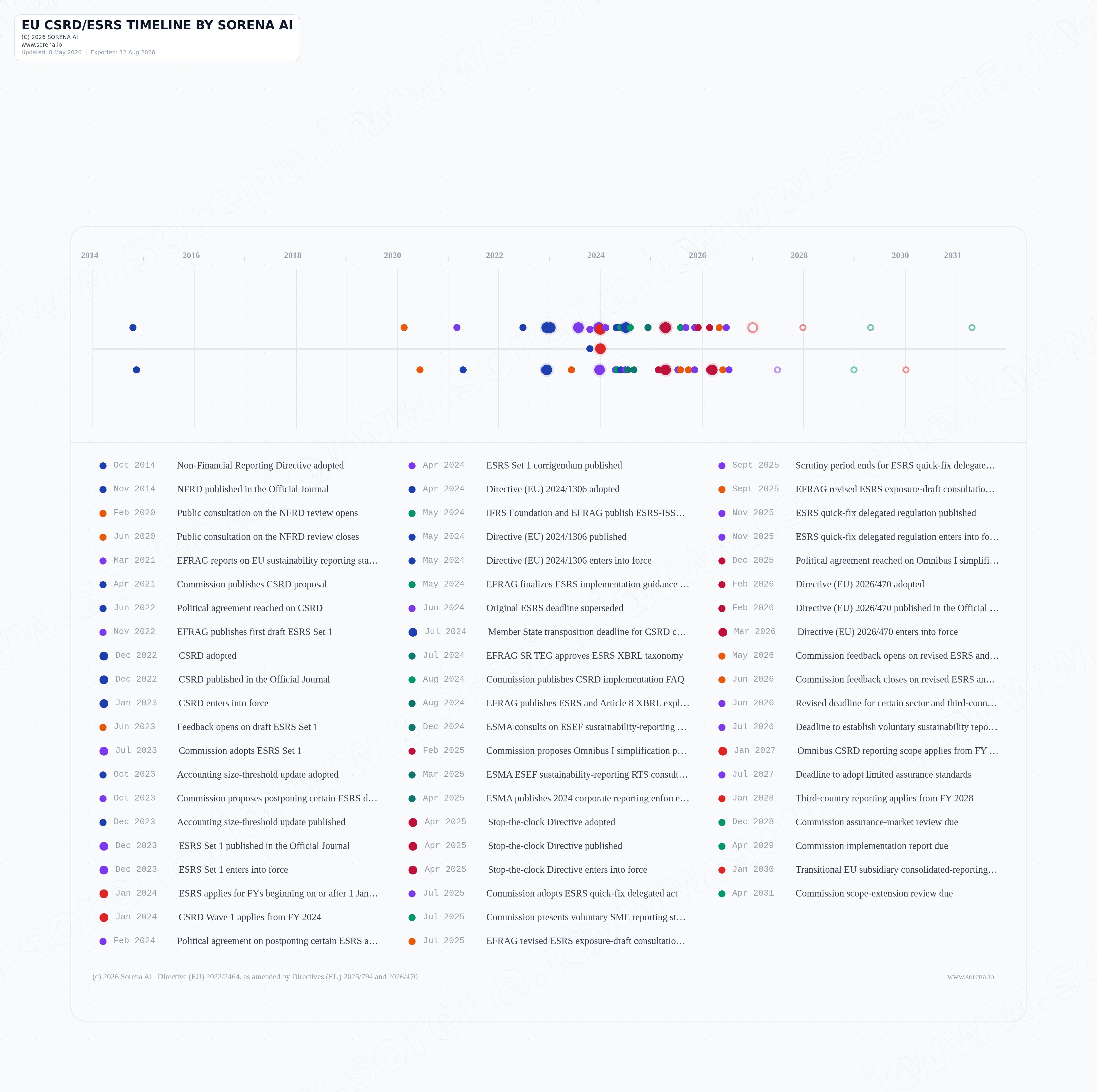
EU CSRD artifact preview
Share it internally
Download the timeline export to align legal, product, engineering, and commercial teams on milestones and deadlines.