EU Data Act Scope, Data Access, and Switching
This hub explains when a is in scope of the EU Data Act, what product data must be made available, which exceptions apply, and which chapter controls the next action.
In plain terms: the Data Act gives qualifying users access to certain data generated by connected products and related services and lets them direct some of that data to third parties. Separate chapters govern mandatory B2B terms, exceptional public-sector requests, and switching between data processing services; those chapters can apply even when the connected-product rules do not.
Regulation (EU) 2023/2854 has applied since 12 September 2025. Use the chapter guides to validate product scope, access, B2B terms, public-sector requests, and cloud switching against the binding text and the facts of the case.
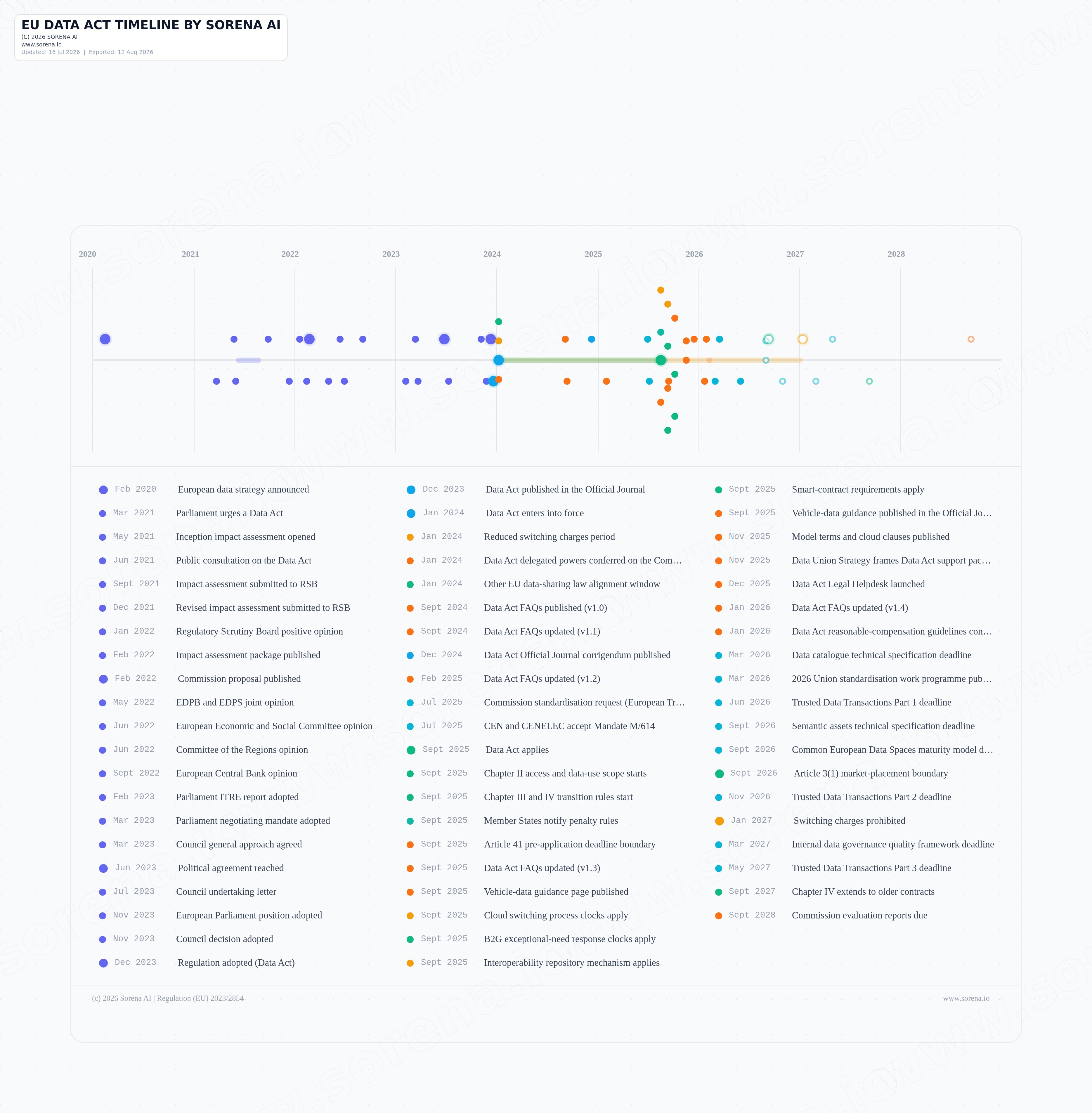
Key dates for EU Data Act application
Track the Regulation's entry into force, general application date, Article 3(1) connected-product design date, Chapter IV contract transition, and the cloud switching-charge phase-out.
Choose the next Data Act decision
Start by deciding whether the Data Act applies to the product, service, data, contract, request, or cloud service in front of you. Then move to the access, contract, switching, evidence, deadline, or comparison guide that matches that decision.
Start here: scope, actors, and data
Identify the regulated situation, the connected product or related service, the data in scope, and whether the organisation is acting as user, data holder, data recipient, third party, or service provider.
Data sharing, contracts, and safeguards
Build the correct disclosure and contract path for users, recipients, public-sector bodies, and automated data-sharing arrangements while protecting security and trade secrets.
Cloud switching and interoperability
Map the customer exit process, contractual clocks, exportable data and digital assets, switching charges, functional-equivalence boundary, and applicable interoperability work.
Implementation, dates, and evidence
Translate the assigned chapter into owned controls, retained evidence, application dates, enforcement decisions, and sector-specific implementation work.
Compare regimes or answer a focused question
Keep the Data Act separate from GDPR and the Data Governance Act, or use the FAQ when you already know the specific scope, access, contract, switching, or enforcement question to resolve.
Assign EU Data Act scope to owned implementation work
This hub is the shared starting point for product, legal, data, procurement, cloud, and public-sector request teams. Confirm the factual boundary first, then assign the Data Act chapter, request path, contract update, technical control, and retained record.
- Start with one product, , dataset, B2B clause, public-sector request, cloud contract, data-space integration, or smart-contract deployment.
- Use Research Copilot for cited answers about scope, actor roles, application dates, Chapter II access, Chapter V exceptional need, Chapter VI switching, and Article 36 smart contracts.
- Use SSOT to retain source links, request logs, contract positions, trade-secret measures, security restrictions, cloud exit records, and authority communications in one governed file.
- Keep unresolved interpretation questions separate from confirmed implementation tasks so product and contract teams do not treat assumptions as obligations.