China Telecom and Wireless Compliance Guide
Decide whether a China connected-device launch needs telecom , , treatment, mobile-terminal app controls, or several routes in parallel.
Use the timeline for fixed legal dates, then follow the grouped guides for scope, approval evidence, release and change control.
MIIT controls telecom equipment network access and national radio-equipment rules; provincial radio authorities handle the station licences triggered by specified deployments. Start with the finished model's public-network functions, radio bands and antenna, deployment environment, operating system and preinstalled apps. Check the current equipment catalogue and later MIIT reforms instead of assuming every connected product follows the same approval route.
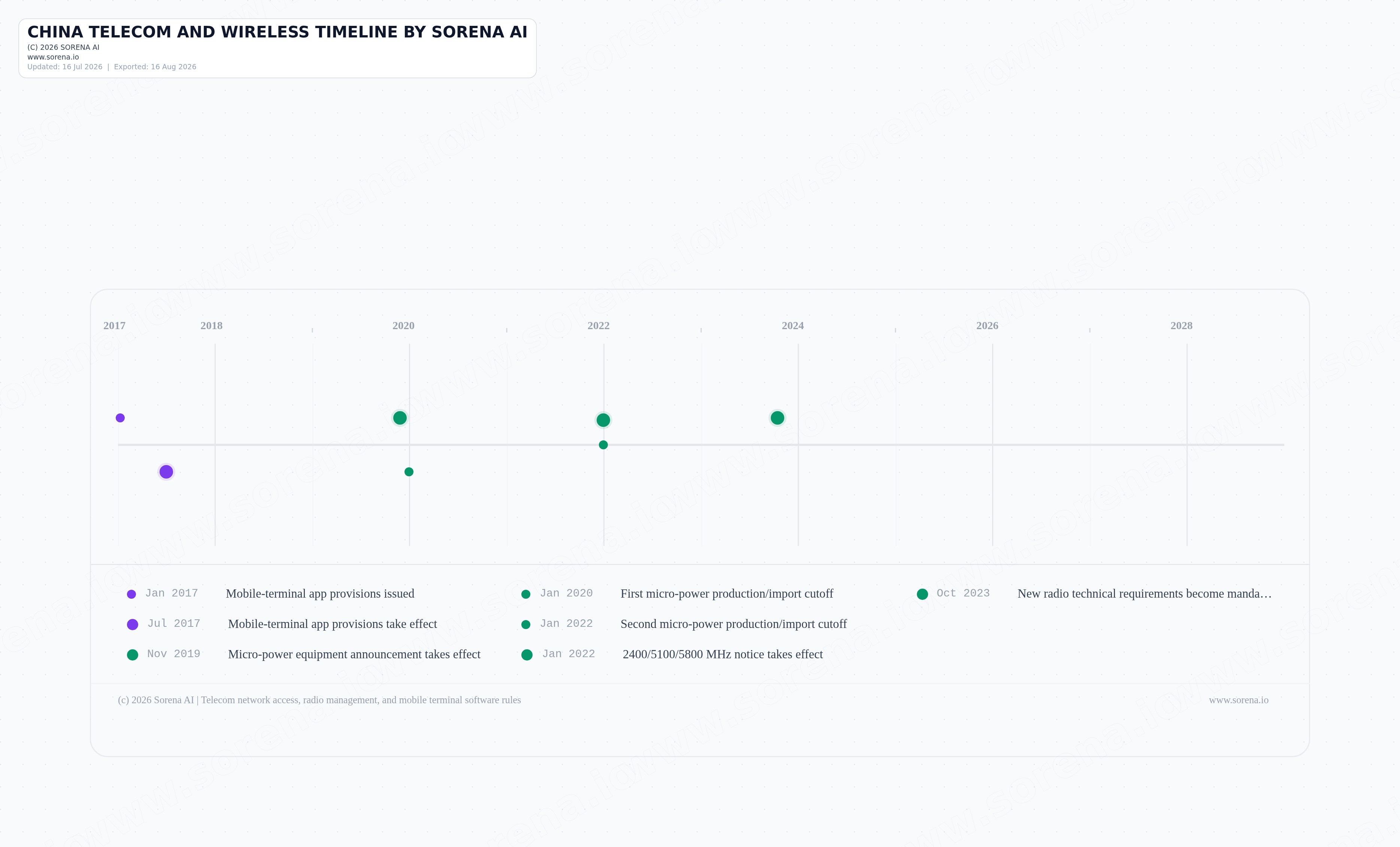
Key dates for China Telecom and Wireless
Separate rule commencement and historical transition dates from model-specific application, certificate-expiry, renewal and product-change dates.
Choose the next China launch decision
Start with the launch workflow and requirements map. Then open the approval, radio, software, evidence or deadline guide that matches the finished model.
Start here
Classify the finished model and identify every applicable route before arranging tests.
Network access permission
Confirm catalogue scope, applicant, application evidence, timing, marking and lifecycle duties.
Radio route
Separate ordinary model approval, band-specific controls and catalogue-based micro-power treatment.
Mobile-terminal software
Review preinstalled-app governance, user information, consent, removal and build consistency.
Deadlines, enforcement and questions
Calendar model-specific deadlines, understand supported enforcement consequences and answer focused route questions.
Prepare the China connected-device launch file
Sorena AI turns China network-access, radio and mobile-terminal software requirements into model-specific decisions, evidence records, owners and change reviews.
- Start with the finished model, public-network function, radio configuration, deployment environment and China software build that create the approval question.
- Research Copilot keeps the cited rule, decision owner, evidence record, and approval history connected.
- SSOT preserves cited rules, model facts, approval evidence and refresh history when the manufacturer, hardware, radio, antenna or app build changes.