Manual coordination drains GRC capacity
Regulatory changes, customer questionnaires, audits, certifications, and internal reviews arrive continuously. Each can trigger another cycle of context switching, manual coordination, and duplicated work.
Teams spend time translating regulations, finding evidence, reconciling versions, and answering the same questions in slightly different formats. Sorena AI handles more of that preparation so people can focus on the decisions.
Reduce fragmentation across GRC work
Laws change, standards evolve, and organizations operate across products, regions, and teams. The information needed for GRC work is often scattered across documents, drives, tools, and inboxes.
Unclear ownership, misaligned timelines, and repeated handoffs can delay answers and leave teams working from stale information. A shared system reduces that fragmentation even when the underlying work remains complex.
Why traditional GRC tools do not scale
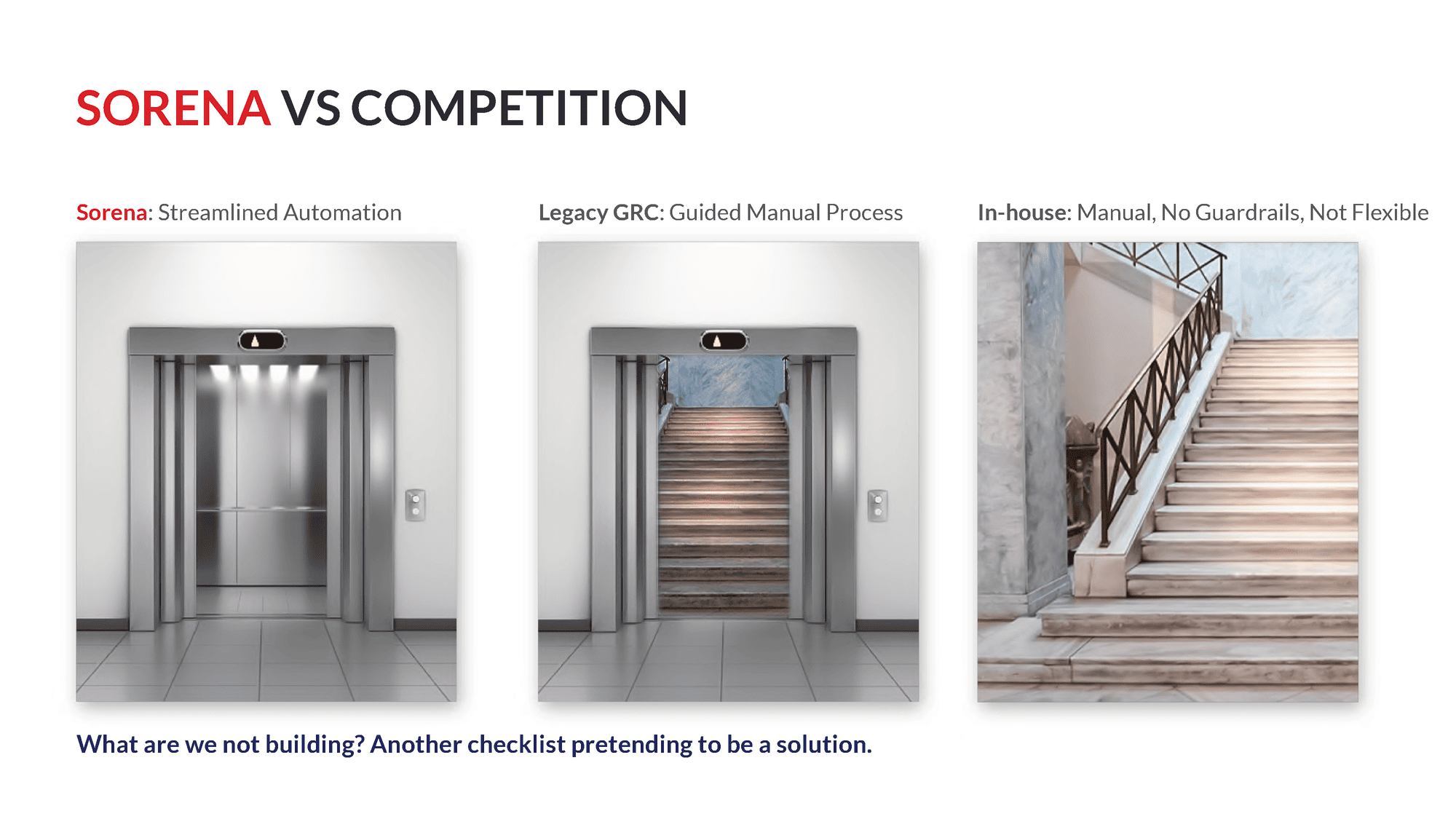
Traditional GRC tools focus on tracking tasks, deadlines, and owners. Teams may still have to interpret requirements, find source material, collect evidence, and package the result for customers or auditors.
When progress depends on reminders, meetings, and manual follow-ups, workload rises with volume. Tracking is most useful when the system also helps move the work forward.
Compare tracking with execution on one workflow
A tracking tool records that a control review is due. An execution system helps complete it. It pulls the requirement, finds the latest evidence, drafts the control response, flags missing proof, routes the exception to the owner, records approval, and keeps the evidence trail.
That is the line Sorena has to keep clear. Humans still decide whether the evidence is good enough. The system does the collecting, mapping, routing, and assembly that used to consume the week before the decision. Tracking tells you work exists. Execution moves it forward.
A better model: humans decide, systems execute
People focus on judgment, prioritization, and risk decisions. Systems handle collection, mapping, tracking, and assembly.
This model needs a Single Source of Truth, traceability for every answer, and repeatable automation.
How the day-to-day work changes
Sorena AI brings regulatory intelligence, internal knowledge, and operational workflows into one governed system. Actions are grounded in the same source of truth to reduce repeated coordination and inconsistent answers.
Research is evidence-backed. Teams ask questions in plain language and receive answers linked to supporting material. People make the judgment calls.
Assessments reuse prior work. Questionnaires such as CAIQ and customer RFPs, frameworks such as ISO 27001, NIS2, SOC 2, GDPR, and the Data Act, and internal or external audits can run as structured workflows. The system extracts requirements, maps obligations, assigns actions, attaches evidence, and records the audit trail.
Evidence can accumulate as the work happens instead of being collected only before an audit.
What leaders experience after the shift
Leaders can review traceable facts instead of asking teams to reconstruct them. Teams working from the same information, priorities, and timelines need fewer reconciliation steps.
Sorena flags gaps, recommends actions, and gives teams a structured path through remediation. People retain control over approvals and risk decisions.
What Sorena AI will not do
Sorena AI does not treat compliance as a checkbox or a black-box decision engine. Human oversight stays central. Leaders approve outcomes, handle exceptions, and make risk trade-offs. The system shows its work. You stay in control.
Start small, move fast
Begin with one high-friction flow that already consumes time: a regulatory requirement, industry standard, customer questionnaire, vendor review, or recurring audit.
Run that flow end to end and review which handoffs, evidence requests, and ownership gaps the system removed. Once it works, add other processes to the same foundation.
Frequently asked questions
How is Sorena different from a traditional GRC platform?+
Traditional platforms track tasks, deadlines, and owners. Sorena executes the last mile: it interprets requirements, retrieves source material, maps obligations, assembles evidence, and produces audit-ready outputs, all grounded in a Single Source of Truth with a full audit trail.
Do we need a big rollout to get value?+
No. Start by running one high-friction workflow end to end, such as a customer questionnaire, recurring audit, or specific regulation. Review the result before expanding onto the same foundation.
Does automation remove human oversight?+
No. Humans make the judgments, approvals, and risk trade-offs. Sorena handles collection, mapping, tracking, and assembly, and always shows its work so you stay in control.
Sources
- ISACA, A Proactive, Continuous Approach to Automated Compliancehttps://www.isaca.org/resources/news-and-trends/isaca-now-blog/2024/a-proactive-continuous-approach-to-automated-compliance?ref=sorena.io
- NIST, Artificial Intelligence Risk Management Frameworkhttps://www.nist.gov/itl/ai-risk-management-framework?ref=sorena.io