MDRRegulation (EU) 2017/745

EU Medical Device Regulation Compliance Hub

Use this MDR hub as a root overview for medical devices placed on the EU market. Start with intended purpose and product boundary, confirm whether the product is a medical device, accessory or Annex XVI product without an intended medical purpose, then connect classification, conformity assessment, technical documentation, clinical evaluation, UDI, EUDAMED, PMS, vigilance and legacy-transition evidence to the same device file.

Regulation (EU) 2017/745 replaced the active implantable and medical device directives with one MDR framework for devices other than in vitro diagnostic medical devices. The practical path is evidence-led: document the intended purpose, justify the Annex VIII risk class, identify whether notified body involvement is required, maintain Annex II and III technical documentation, support the clinical evaluation under Article 61 and Annex XIV, and keep post-market surveillance, vigilance, UDI and EUDAMED records current through the device lifecycle.

Run the MDR applicability test
Publication details
Editorial metadata for this artifact
Author
Sorena AI
Published
Feb 22, 2026
Updated
May 26, 2026
What this hub helps you check
Device qualification and scope
Confirm medical purpose, accessory status, software function, Annex XVI coverage, borderline signals, and the economic-operator role for the EU market route.
Risk class and conformity route
Apply Annex VIII classification, including software Rule 11 where relevant, then map the result to the MDR conformity assessment route and notified body involvement.
Lifecycle evidence
Tie technical documentation, clinical evaluation, PMCF, PMS, PSUR where applicable, vigilance, UDI assignment, EUDAMED registration and legacy-transition records to one controlled device history.
By Sorena AIGrounded in official EU sourcesNo signup required
Quick scan
MDR
Start with intended purpose
The MDR qualification question turns on what the manufacturer intends the product to do for human beings. Software, accessories and Annex XVI products need the same disciplined scope record before classification or CE planning.
Classify before choosing the route
Classification is not a label exercise. Record the applicable Annex VIII rule, invasiveness, duration of use, active or implantable status, substance or nanomaterial features, software decision impact, and any rule that drives a higher class.
Build a living evidence file
Keep Annex II and III technical documentation, risk management, GSPR mapping, clinical evaluation report, PMCF plan or rationale, PMS plan, vigilance procedure, UDI data and EUDAMED actor/device records aligned with the released device.
Use the topic guides to move from MDR scope and classification into technical-file readiness, notified body planning, clinical evidence, PMS/vigilance operations, UDI/EUDAMED setup and legacy-device transition checks.
2017/745
Regulation
Annex VIII
Classification
Annex II + III
Technical file
Article 61
Clinical evaluation
UDI
Traceability
Qualify device scope
Classify risk
Prepare evidence
MDR Reference Points

Key records for medical device compliance

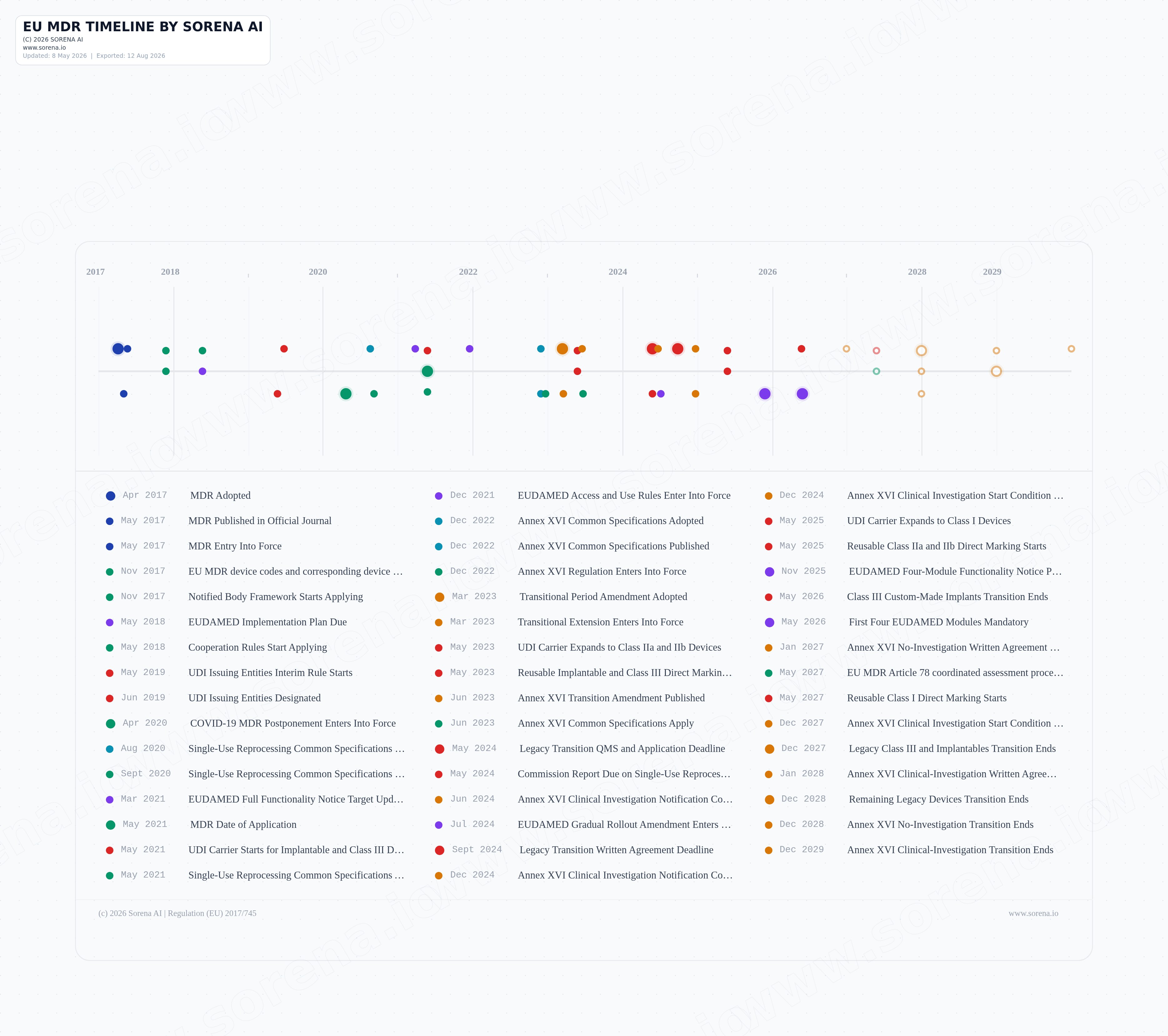
Track MDR application, Article 120 legacy-device conditions, notified body application and agreement evidence, technical documentation updates, clinical evaluation and PMCF outputs, PMS/vigilance records, UDI assignment, EUDAMED actor and device registration, certificate status, and market-surveillance correspondence for each device family.

Loading timeline...

Topic guides

Deep dive pages for implementation planning, controls, reporting, and evidence.

1
EU MDR Annex II and III Technical Documentation
Build an MDR technical documentation index for Annex II device files and Annex III post-market surveillance evidence, including GSPR, risk, clinical, PMS, UDI, and EUDAMED records.
Read Guide
2
EU MDR Annex VIII Classification Guide
Classify EU MDR medical devices under Annex VIII using intended purpose, duration, invasiveness, active device and software rules, and conformity assessment impact.
Read Guide
3
EU MDR Annex XVI products without a medical purpose
source-linked EU MDR guide for Annex XVI products: listed product groups, common specifications, clinical evidence, notified-body route, UDI, EUDAMED, PMS, and vigilance evidence before launch.
Read Guide
4
EU MDR Applicability Test
Test whether a product, accessory, software function, or Annex XVI product falls under the EU Medical Device Regulation, and record the evidence for the next classification step.
Read Guide
5
EU MDR change assessment workflow
Assess EU MDR device, design, software, intended purpose, QMS, clinical, PMS, UDI, classification, and notified-body impacts before releasing a medical device change.
Read Guide
6
EU MDR Checklist for Medical Device Compliance
Practical EU MDR checklist covering qualification, classification, conformity assessment, technical documentation, GSPR, clinical evidence, UDI, EUDAMED, PMS, vigilance, QMS, and legacy transition evidence.
Read Guide
7
EU MDR classification workflow
A concrete EU MDR classification workflow for intended purpose, device or accessory qualification, Annex VIII rule selection, Rule 11 software review, class outcome, and notified body impact.
Read Guide
8
EU MDR Clinical Evaluation Overview
EU MDR clinical evaluation overview covering Article 61, Annex XIV, clinical data sources, equivalence, PMCF, CER evidence, notified body review, GSPR, and benefit-risk support.
Read Guide
9
EU MDR Clinical Evaluation Report Template
A source-linked EU MDR clinical evaluation report template covering intended purpose, GSPR linkage, clinical data appraisal, equivalence limits, PMCF, conclusions, and reviewer signoff.
Read Guide
10
EU MDR clinical evidence guide
source-linked EU MDR guide to clinical evaluation, clinical investigations, equivalence, PMCF, GSPR support, technical documentation, and notified-body review.
Read Guide
11
EU MDR compliance obligations
EU MDR compliance guide for device qualification, classification, conformity assessment, QMS, technical documentation, UDI, EUDAMED, PMS, vigilance, and legacy transition controls.
Read Guide
12
EU MDR conformity route workflow
source-linked EU MDR workflow for classifying a device, choosing the conformity assessment route, preparing technical and QMS evidence, and reaching certificate, DoC, UDI, EUDAMED, and CE outputs.
Read Guide
13
EU MDR deadlines and compliance calendar
Grounded EU MDR calendar for application, legacy-device transition, UDI, EUDAMED, and recurring QMS, technical documentation, clinical, PMS, vigilance, certificate, and change reviews.
Read Guide
14
EU MDR Device Classification Guide
Classify an EU MDR medical device by intended purpose, Annex VIII duration, invasiveness, active-device and software rules, then document the conformity route impact.
Read Guide
15
EU MDR EUDAMED and UDI registration
source-linked MDR guide to Basic UDI-DI, UDI-DI, EUDAMED device registration, actor roles, labels, technical documentation, and UDI data governance.
Read Guide
16
EU MDR FAQ: qualification, evidence, UDI, and transition
Concise EU MDR FAQ covering device qualification, software classification, accessories, custom-made devices, clinical evidence, UDI, EUDAMED, notified bodies, significant changes, and legacy transition.
Read Guide
17
EU MDR Legacy Device Transition
source-linked EU MDR legacy device transition guide covering Regulation (EU) 2023/607 conditions, certificate validity, significant-change limits, surveillance, PMS, vigilance, QMS, and evidence records.
Read Guide
18
EU MDR notified body route selection
Choose an EU MDR conformity assessment route by device class, Article 52 option, notified body designation scope, QMS readiness, technical documentation, clinical evidence, and certificate evidence.
Read Guide
19
EU MDR penalties and enforcement risk
source-linked EU MDR penalties and enforcement-risk guide covering Article 113, Member State penalty rules, market restrictions, recalls, certificate consequences, and evidence.
Read Guide
20
EU MDR PMS and Vigilance Guide
EU MDR guide to post-market surveillance, PMCF updates, PMS reports, PSURs, serious incident reporting, FSCA/FSN handling, trend reporting, and evidence records.
Read Guide
21
EU MDR PMS and vigilance records
source-linked EU MDR guide to PMS plans, PMS reports, PSURs, PMCF updates, serious incident and FSCA reporting, trend reporting, and EUDAMED evidence handling.
Read Guide
22
EU MDR PMS Plan Template for Medical Devices
A source-linked EU MDR post-market surveillance plan template covering device scope, PMS data sources, PMCF linkage, vigilance, trend reporting, PMSR or PSUR outputs, roles, cadence, and evidence records.
Read Guide
23
EU MDR QMS and technical file evidence map
Map EU MDR Article 10 QMS duties to Annex II and Annex III technical documentation, PMS, vigilance, UDI records, and notified-body review evidence.
Read Guide
24
EU MDR QMS requirements under Article 10
EU MDR QMS guide for Article 10 manufacturer controls covering regulatory strategy, design, risk, clinical evaluation, PMS, vigilance, UDI, suppliers, CAPA, and conformity records.
Read Guide
25
EU MDR qualification and borderline products
EU MDR qualification guide for medical purpose claims, accessories, software, Annex XVI products, and borderline routes to classification and conformity assessment.
Read Guide
26
EU MDR qualification workflow
A concrete EU MDR workflow for deciding whether a product is a medical device, accessory, Annex XVI product, IVD interface, medicinal-product interface, or non-MDR product before classification and conformity assessment.
Read Guide
27
EU MDR requirements checklist
Concrete EU MDR requirements for medical-device scope, classification, GSPR, conformity assessment, technical documentation, QMS, clinical evidence, UDI, EUDAMED, PMS, vigilance, and economic-operator records.
Read Guide
28
EU MDR Rule 11 software classification
Classify MDR medical device software under Rule 11 using intended purpose, diagnosis or therapy decision impact, physiological monitoring, conformity route, clinical evidence, and software-change records.
Read Guide
29
EU MDR Transition Timelines: practical guide
EU Medical Device Regulation guide to Transition Timelines with scope decisions, owner actions, evidence records, source-linked citations, and practical next steps.
Read Guide
30
EU MDR UDI and EUDAMED registration guide
EU MDR guide to Basic UDI-DI, UDI-DI, UDI carriers, EUDAMED actor and device registration, change impacts, and evidence governance.
Read Guide
31
EU MDR vigilance reporting workflow
Concrete EU MDR vigilance workflow for incident intake, serious incident assessment, FSCA and FSN handling, trend reporting, EUDAMED caveats, CAPA, PMS, clinical evaluation updates, and records.
Read Guide
32
MDR vs AI Act for medical-device software
Compare MDR software qualification, classification, clinical evidence, QMS, PMS, UDI, EUDAMED, and notified-body evidence boundaries against cautiously scoped AI Act overlap.
Read Guide
33
MDR vs GPSR: medical-device boundary checks
Compare MDR medical-device scope with general product-safety fallback questions for borderline, non-medical, and Annex XVI products.
Read Guide
34
MDR vs IVDR: medical devices and IVDs compared
Compare EU MDR and IVDR scope, classification, conformity routes, technical documentation, clinical or performance evidence, UDI, EUDAMED, PMS, and vigilance.
Read Guide
35
MDR vs Product Liability Directive evidence comparison
Compare EU MDR market-access evidence with Product Liability Directive exposure without treating compliance records as a liability outcome.
Read Guide
Next step

Turn MDR scope and evidence into owned device work

Use this hub to route MDR work by device family, intended purpose, risk class, economic-operator role, notified body status, clinical evidence route and EU market path. The output should be a controlled device file, not a one-time checklist.

What this unlocks
  • Start with the product boundary, intended purpose, claims, user population, EU market route, manufacturer and economic-operator roles, Annex XVI or software signals, and any borderline facts that change qualification.
  • Use Assessment Autopilot to request classification rationale, applicable Annex VIII rules, GSPR mapping, risk management records, Annex II and III technical documentation, clinical evaluation, PMCF or justification, PMS plan, PSUR where applicable, vigilance process, UDI data and EUDAMED registration evidence.
  • Use Research Copilot for cited questions about MDR scope, Annex XVI common specifications, Rule 11 software classification, notified body designation scope, conformity assessment routes, clinical evidence expectations, EUDAMED modules and Article 120 legacy-device conditions.
  • Keep design, quality, regulatory, clinical, post-market, distributor, importer, notified body and authority-response records connected to the same device model and Basic UDI-DI.
EU MDR artifact preview
Share it internally
Download the timeline export to align legal, product, engineering, and commercial teams on milestones and deadlines.