EEDDirective (EU) 2023/1791

EU Energy Efficiency Directive Compliance Hub

This hub explains the recast Energy Efficiency Directive (EU) 2023/1791 as several connected workstreams: the energy-efficiency-first principle and EU targets, Member State implementation, enterprise audits and energy management, public-sector and procurement duties, heating and cooling, consumer information, and data-centre reporting.

Official EU sourcesUpdated July 2026No signup required
Root-page scan
EED recast
Energy efficiency first
For relevant public policy and major investment decisions, record whether cost-efficient demand-side or efficiency measures were considered before supply-side expansion.
Enterprise evidence
Keep the enterprise and linked-enterprise boundary, three-year final-energy-consumption calculation, billed energy, renewable self-consumption, all-carrier inputs, EMS certificate or audit report, management-submitted Action Plan for the audit route, recommendation status, and publication/confidentiality assessment.
Public sector and data centres
Maintain public-body baseline and reduction records, building inventories over 250 m2, renovation or alternative-savings files, procurement decisions, heating and cooling assessments, metering and billing evidence, data-centre Annex VII inputs, European database submissions, and the basis for any exclusion.

This hub is a starting point for compliance planning, not a substitute for Member State implementing law or authority guidance.

Key dates
85 TJ
EMS threshold
10 TJ
Audit threshold
500 kW
Data-centre trigger
15 May
Annual DC cadence
What this EED hub helps you identify
Enterprise Article 11 route
Check average annual final energy consumption over the previous three years across all carriers. A result higher than 85 TJ triggers the certified energy management system route; a result higher than 10 TJ triggers the audit route when the enterprise does not implement an EMS. Equality alone does not cross either EU threshold. Commission guidance recommends including linked enterprises in the EU and reassessing the rolling average each year; national law controls the operative method.
Public-sector obligations
Separate Member State duties from the records public bodies may need to supply: the 1.9% annual reduction trajectory, public-building renovation or equivalent savings route, inventories for buildings over 250 m2, planning, and energy-efficient procurement.
Data-centre reporting
For data centres with installed IT power demand of at least 500 kW, identify Annex VII information, public availability rules, confidentiality limits, and reporting cadence.
Energy efficiency first
Article 11
Data centres
Publication details
Editorial metadata for this artifact
Author
Sorena AI
Published
Feb 21, 2026
Updated
Jul 25, 2026

The Directive sets the EU framework, but Member States transpose and administer many duties. Use the EU rules to identify the likely route, then verify how the applicable national law defines the enterprise boundary, authority, forms, exemptions, and enforcement process.

EED timeline

Key milestones for Directive (EU) 2023/1791

Use the timeline alongside national implementation checks: Directive (EU) 2023/1791 entered into force on 10 October 2023; Article 12 data-centre reporting began in 2024 and continues annually; the main transposition deadline was 11 October 2025, although specific provisions use other dates; first Article 11 audits for the higher-than-10-TJ route are due by 11 October 2026; and enterprises above 85 TJ must have an energy management system in place by 11 October 2027.

Loading timeline...
Recommended reading path

Choose the next EED decision

Start by identifying the actor and energy boundary. Then use the relevant enterprise, public-sector, consumer, or data-centre route before moving to evidence, dates, reporting, or comparisons.

1

Start here: scope and routing

Decide whether the issue belongs to an enterprise, public body, public-building portfolio, data centre, or Member State implementation workstream, then calculate the relevant threshold or boundary.

2

Enterprise audits and energy management

Move from the Article 11 threshold result into the audit or certified energy-management-system route, Annex VI quality criteria, action plans, and supporting standards.

EU Energy Efficiency Directive requirements: Article 11, audits, data centres
Core EED requirements explained by actor: Article 11 audits and EMS, data centres, public bodies, procurement, heating and cooling, and evidence.
Read guide
EU EED Article 11 Energy Audits: 10 TJ threshold, cadence, and evidence
Source-backed guide to Energy Efficiency Directive Article 11 energy audit obligations, including the 10 TJ trigger, four-year cadence, Annex VI criteria, EN 16247 relation, and action-plan evidence.
Read guide
EU Energy Efficiency Directive Article 11 energy management systems
Article 11 EMS guide for enterprises higher than 85 TJ, covering certified energy management systems, the separate audit route, energy data, and evidence.
Read guide
EU Energy Efficiency Directive Article 11 EMS vs Energy Audit Route
Compare Article 11 EMS and energy audit routes under Directive (EU) 2023/1791: 85 TJ and 10 TJ thresholds, three-year average consumption, Annex VI audit criteria, outputs, and evidence.
Read guide
Annex VI energy audit criteria under the EU Energy Efficiency Directive
A source-backed guide to the Annex VI minimum criteria for EU Energy Efficiency Directive energy audits: data quality, representative scope, LCCA, calculations, recommendations, and evidence.
Read guide
EN 16247-1 audit structure under the EU Energy Efficiency Directive
How to structure an EN 16247-1 energy audit for EED Article 11 and Annex VI: scope, data, site work, analysis, report outputs, recommendations, and evidence.
Read guide
EED Article 11 action plans and national planning context
How EU Energy Efficiency Directive action plans work: Article 11 audit-based enterprise plans, management submission, publication evidence, and the difference from national NEEAP and NECP planning.
Read guide
3

Public sector, consumers, and data centres

Use the distinct routes for public-body consumption, renovation and procurement, heating and cooling metering and billing, and Article 12 data-centre transparency.

4

Implementation and evidence

Turn the selected route into owned controls, traceable calculations, audit and reporting records, management approvals, publication decisions, and national-law checks.

5

Dates, reporting, and monitoring

Separate historical milestones and Member State deadlines from enterprise and data-centre dates, then maintain the evidence and implementation indicators over time.

6

Compare frameworks or answer a specific question

Understand where EED evidence can support ISO 50001, CSRD, or EPBD work without treating those frameworks as substitutes, or go directly to a focused FAQ.

Next step

Turn EED obligations into owned evidence work

This hub is the shared entry point for EED scoping, threshold calculations, national-law checks, audit and energy-management evidence, public-sector records, and data-centre reporting files.

What this unlocks
  • Start with the legal entity, Member State, activity boundary, energy carriers, public-body status, and data-centre installed IT power demand.
  • Use ESG Compliance to track EED work by entity, facility, public body, procurement process, data centre, evidence owner, and reporting period.
  • Use Assessment Autopilot to request Article 11 energy-consumption calculations, EMS certificates, audit reports, management Action Plans, publication evidence, and national implementation checks.
  • Escalate uncertain facts before filing or publication, especially threshold calculations, confidentiality claims, public-sector coverage, and Member State-specific forms.
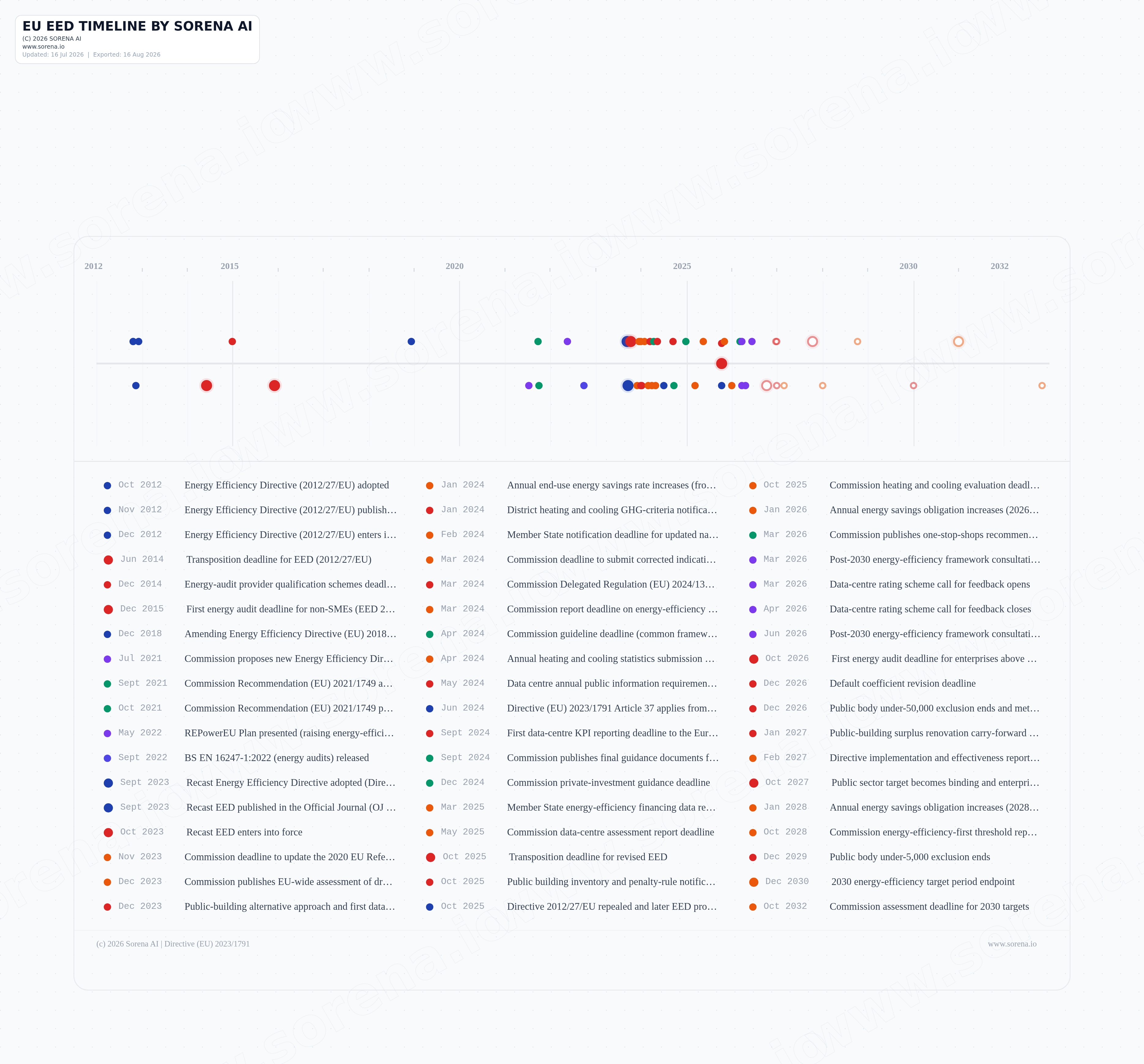
EU Energy Efficiency Directive artifact preview
Share it internally
Download the timeline export to align legal, product, engineering, and commercial teams on milestones and deadlines.