DSAEU Platform Regulation

EU Digital Services Act Scope, Platform Duties, and VLOP Readiness

Use this DSA hub to classify an online service, identify the obligations that attach to each service tier, and route work into notice-and-action intake, statements of reasons, complaint handling, transparency reports, advertising and recommender disclosures, trader checks, and VLOP/VLOSE systemic-risk controls.

This is source-linked implementation guidance, supporting implementation planning and should be validated against jurisdiction-specific legal, contractual, and policy requirements before implementation. DSA duties depend on whether the service is an intermediary, hosting service, online platform, online marketplace, online search engine, or Commission-designated very large online platform or very large online search engine.

Open the DSA checklist
Publication details
Editorial metadata for this artifact
Author
Sorena AI
Published
Feb 23, 2026
Updated
May 26, 2026
DSA questions this hub helps answer
Which service tier applies?
Start with intermediary-service scope and then separate hosting, online platform, marketplace, and search-engine features because each layer adds obligations.
Which trust-and-safety controls are required?
Map notice and action, trusted-flagger priority, statement-of-reasons delivery, internal complaints, out-of-court dispute links, repeat-abuse suspension, and transparency reporting.
Is the service in VLOP or VLOSE territory?
Track average monthly active EU recipients against the 45 million threshold, designation status, four-month compliance trigger, systemic-risk assessment, mitigation, audit, data access, and ad-repository work.
By Sorena AIUpdated 2026-05No signup required
DSA quick scan
Regulation 2022/2065
Scope and service boundary
The DSA regulates intermediary services that connect recipients with goods, services, or content; Commission guidance lists marketplaces, social networks, app stores, travel platforms, and accommodation platforms as examples.
Core operating duties
Hosting and platform teams need operational records for Article 16 notices, Article 17 statements of reasons, Article 15 transparency reports, Article 24 user numbers, Article 26 ads, Article 27 recommenders, and Article 30 trader traceability where relevant.
Enhanced VLOP/VLOSE layer
Designated services at or above 45 million average monthly active EU recipients must handle systemic-risk assessment and mitigation, annual independent audits, researcher and regulator data access, non-profiling recommender options, and searchable ad repositories.
Use the topic guides to move from DSA scoping into article-level controls, public disclosures, reporting templates, marketplace checks, and enforcement readiness.
2022/2065
Regulation
Art. 16-17
Moderation
45M
VLOP/VLOSE
6%
Fine cap
Service classification
Notice and action
Transparency reports
DSA Milestones

Track source-linked DSA applicability and reporting events

Use the DSA milestones for regulation application, VLOP/VLOSE designation effects, average monthly active recipient publication, transparency-reporting templates, audit outputs, and enforcement events only where the source material supports the date and affected service category.

Loading timeline...

Topic guides

Deep dive pages for implementation planning, controls, reporting, and evidence.

1
DSA Ads and Recommender Systems: transparency duties, user choice, and evidence
A grounded DSA guide to ad labels, targeting restrictions, recommender parameter disclosure, non-profiling options for VLOPs and VLOSEs, ad repositories, and compliance evidence.
Read Guide
2
DSA Applicability Test: classify intermediary services, platforms, marketplaces, VLOPs and VLOSEs
A source-grounded EU Digital Services Act applicability test for classifying intermediary services, hosting services, online platforms, marketplaces, VLOPs and VLOSEs.
Read Guide
3
DSA Article 28 minors protection guide for online platforms
EU Digital Services Act guide to Article 28 minors protection: platform scope, child-safety measures, targeted ads limits, recommender controls, and grounded evidence.
Read Guide
4
DSA Complaint and Dispute Workflows for Online Platforms
Build DSA complaint, appeal, statement-of-reasons, and out-of-court dispute workflows for online platform moderation decisions.
Read Guide
5
DSA crisis response for VLOPs and VLOSEs
EU Digital Services Act crisis response guide for VLOPs and VLOSEs: Article 36 Commission decisions, Article 48 crisis protocols, mitigation, governance, requests for information, and records.
Read Guide
6
DSA Dark Patterns: interface design checks for online platforms
Article 25 DSA guidance for reviewing online platform interfaces for deceptive, manipulative, or choice-distorting design patterns.
Read Guide
7
DSA Enforcement and Penalties in the EU
How Digital Services Act enforcement works: Commission and Digital Services Coordinator roles, VLOP and VLOSE investigations, fines, periodic penalty payments, and evidence readiness.
Read Guide
8
DSA Marketplace Trader Traceability Guide
EU Digital Services Act guide for online marketplaces collecting, checking, displaying, storing, and evidencing trader traceability information.
Read Guide
9
DSA notice and action plus statements of reasons guide
A grounded Digital Services Act guide for notice intake, moderation decisions, statements of reasons, DSA Transparency Database submission, complaints, appeals, trusted flaggers, and records.
Read Guide
10
DSA Notice and Action Workflow for Hosting Services and Online Platforms
A grounded DSA notice-and-action workflow covering notice intake, completeness checks, trusted flaggers, decisions, user communications, statements of reasons, appeals, and records.
Read Guide
11
DSA researcher data access for VLOPs and VLOSEs
Article 40 DSA guide to vetted researcher data access for VLOPs and VLOSEs: DSC requests, eligibility checks, amendment grounds, confidentiality, security, and evidence records.
Read Guide
12
DSA service tier classifier for platforms, marketplaces, VLOPs and VLOSEs
Classify a digital service under the EU Digital Services Act as intermediary, hosting, online platform, marketplace, VLOP or VLOSE, with EU recipient-count evidence and obligation outputs.
Read Guide
13
DSA statement of reasons log workflow for online platforms
Build a DSA statement of reasons log for moderation decisions, Transparency Database submission, complaint links, retention, and QA controls.
Read Guide
14
DSA transparency report template fields and cadence
A source-grounded template outline for Digital Services Act transparency reports, covering applicable service tiers, reporting periods, CSV/XLSX format, retention, statement-of-reasons links, and required evidence tables.
Read Guide
15
DSA Transparency Reporting Obligations by Provider Tier
A grounded guide to EU Digital Services Act transparency reports, active-recipient publication, statements-of-reasons submissions, VLOP/VLOSE reports, templates, cadence, and evidence.
Read Guide
16
DSA VLOP and VLOSE Risk Assessments and Mitigation Guide
Grounded guide to Digital Services Act systemic risk assessments, mitigation measures, audits, transparency reports, data access, and governance evidence for VLOPs and VLOSEs.
Read Guide
17
DSA VLOP Audit Pack Workflow: Risk, Mitigation, Audit, and Transparency Records
Build a DSA VLOP or VLOSE audit pack covering Article 34 risk assessments, Article 35 mitigations, independent-audit evidence, transparency reports, data access, and compliance governance.
Read Guide
18
DSA vs DMA Platform Rules
Compare the EU Digital Services Act and Digital Markets Act by scope, designation thresholds, obligations, enforcement, evidence, and practical team ownership.
Read Guide
19
DSA vs GDPR: online-platform governance and personal-data obligations
Compare the EU Digital Services Act and EU GDPR by scope, ads, recommenders, minors, transparency, complaints, enforcement, and evidence.
Read Guide
20
DSA vs P2B Regulation: EU platform obligations compared
Compare the EU Digital Services Act with the Platform-to-Business Regulation for platform scope, business-user terms, content moderation, ranking transparency, complaints, enforcement, and evidence.
Read Guide
21
DSA vs Terrorist Content Online Regulation: notice-and-action vs removal orders
Compare DSA content-governance duties with the EU Terrorist Content Online Regulation removal-order workflow for scope, timing, evidence, authorities, and team ownership.
Read Guide
22
EU Digital Services Act checklist for platforms and hosting services
A grounded DSA checklist for classifying service tiers, notice-and-action, statements of reasons, complaints, transparency reports, ads, recommenders, trader traceability, VLOP/VLOSE duties, and evidence records.
Read Guide
23
EU Digital Services Act Compliance Guide
DSA compliance guide for intermediary services, hosting providers, online platforms, marketplaces, and VLOP/VLOSE teams: obligations, controls, and evidence to keep.
Read Guide
24
EU Digital Services Act FAQ: DSA scope, platform duties, VLOPs, reports, and penalties
Concise EU Digital Services Act FAQ covering intermediary-service scope, active-recipient thresholds, illegal-content notices, statements of reasons, trader traceability, recommender transparency, systemic-risk duties, reporting, penalties, and complaints.
Read Guide
25
EU Digital Services Act penalties and fines: caps and enforcement roles
DSA penalty caps and enforcement roles: Member State fines, Commission fines for VLOPs and VLOSEs, 1% procedural fines, and 5% periodic penalty payments.
Read Guide
26
EU Digital Services Act requirements by service tier
Overview of DSA obligations for intermediary services, hosting providers, online platforms, marketplaces, VLOPs and VLOSEs, including notices, complaints, ads, transparency reports, audits, data access and enforcement.
Read Guide
27
EU Digital Services Act service types and scope
Classify DSA service scope across mere conduit, caching, hosting, online platforms, marketplaces, online search engines, and VLOP/VLOSE threshold duties.
Read Guide
28
EU DSA deadlines and compliance calendar: application dates, reporting cycles, and VLOP clocks
Calendar view of grounded EU Digital Services Act dates: full application, user-number publication, VLOP/VLOSE designation clocks, statements of reasons, and transparency reporting cycles.
Read Guide
29
EU DSA Transparency Calendar: reporting, SoR database, AMAR updates
Build a DSA transparency calendar for annual reports, statement-of-reasons database submissions, active-recipient updates, and VLOP/VLOSE audit touchpoints.
Read Guide
30
EU DSA vs UK Online Safety Act: scope, duties, regulator, and evidence
Compare the EU Digital Services Act and UK Online Safety Act for platform scope, risk assessments, child protection, transparency, regulators, enforcement, and owners.
Read Guide
Next step

Turn DSA scope into controls, disclosures, and evidence

Use this hub as the shared starting point for DSA implementation. Confirm the service tier first, then assign article-level work to trust and safety, policy, legal, marketplace, ads, recommender, data, reporting, and engineering owners who can change the service and maintain the public evidence.

What this unlocks
  • Start with one service boundary: EU targeting or establishment, intermediary role, hosting function, online-platform features, marketplace distance-contract flows, online search, average monthly active EU recipients, and any Commission designation status.
  • For hosting and online-platform workflows, operationalize intake and user remedies: Article 16 notices, trusted-flagger priority, Article 17 statements of reasons, internal complaint handling, out-of-court dispute signposting, repeat-abuse suspension, and DSA Transparency Database submissions where applicable.
  • For ads, recommenders, and marketplace flows, check the user interface: ad labels and sponsor/payment information, recommender main parameters and choice controls, profiling restrictions for minors, trader identity checks, product or service information fields, and consumer notices for illegal offers.
  • For VLOPs and VLOSEs, build a standing evidence pack: user-number methodology, systemic-risk assessment, mitigation measures, compliance function governance, independent audit, audit implementation report, regulator and vetted-researcher data access process, non-profiling recommender option, and ad repository.
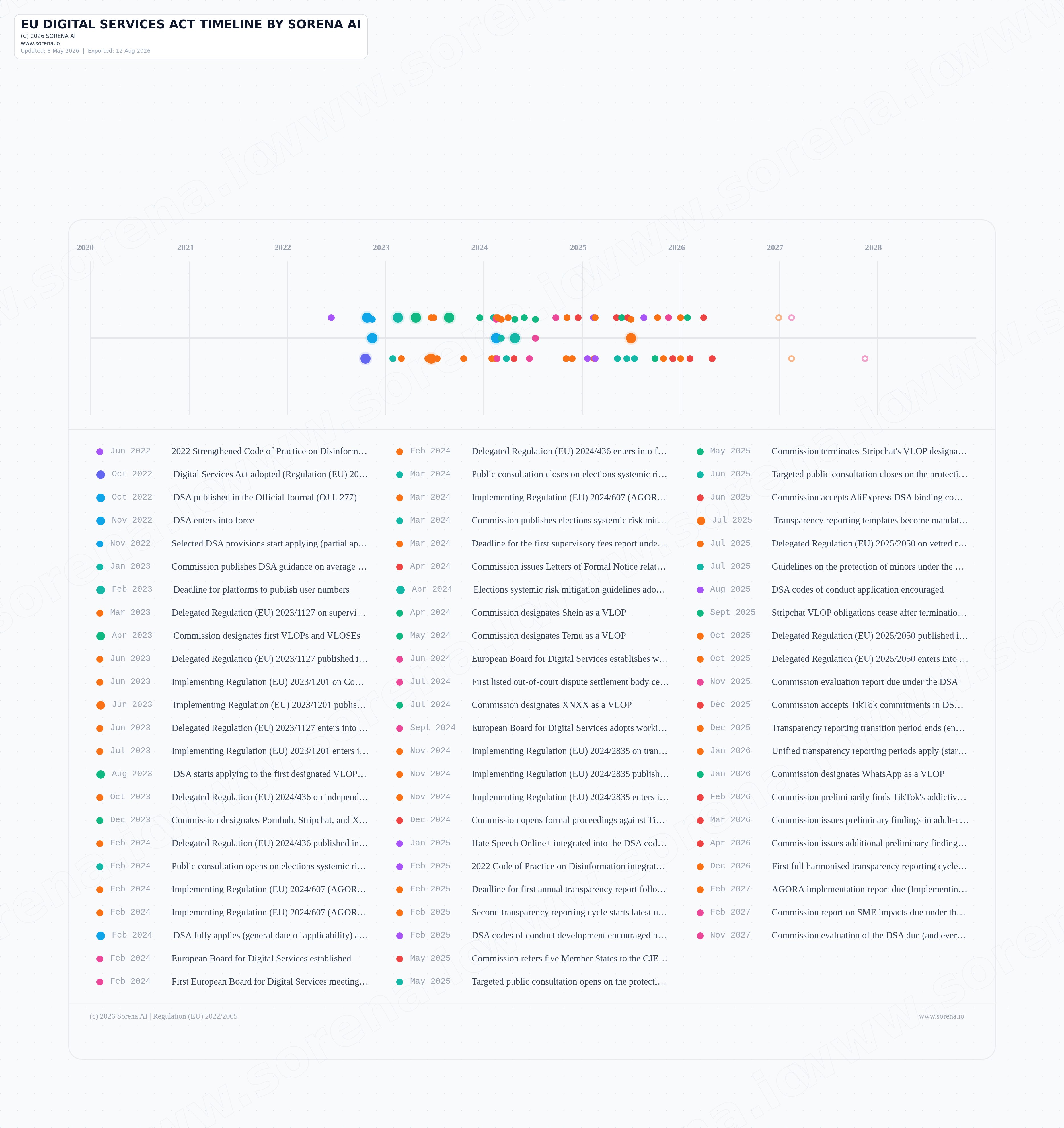
EU DSA artifact preview
Share it internally
Download the timeline export to align legal, product, engineering, and commercial teams on milestones and deadlines.