EU eIDAS Trust Services and Wallet Readiness
Use this hub to apply Regulation (EU) No 910/2014 as amended by Regulation (EU) 2024/1183. It separates notified electronic identification, and qualified status, and European Digital Identity Wallet roles instead of treating every digital identity or e-signature workflow as the same eIDAS question.
Follow the grouped guides in order: decide scope and role, classify the service and legal effect, verify qualified status, map implementation evidence, and only then assign deadlines and monitoring.
Start with the actor and regulated service. Article 2 covers Member State-notified eID schemes, EUDI Wallets provided by or on behalf of Member States, and trust service providers established in the Union. It excludes used exclusively in closed systems created by national law or agreements among a defined set of participants. It also leaves national or Union rules on contract formation, validity, legal obligations, and procedural form requirements untouched.
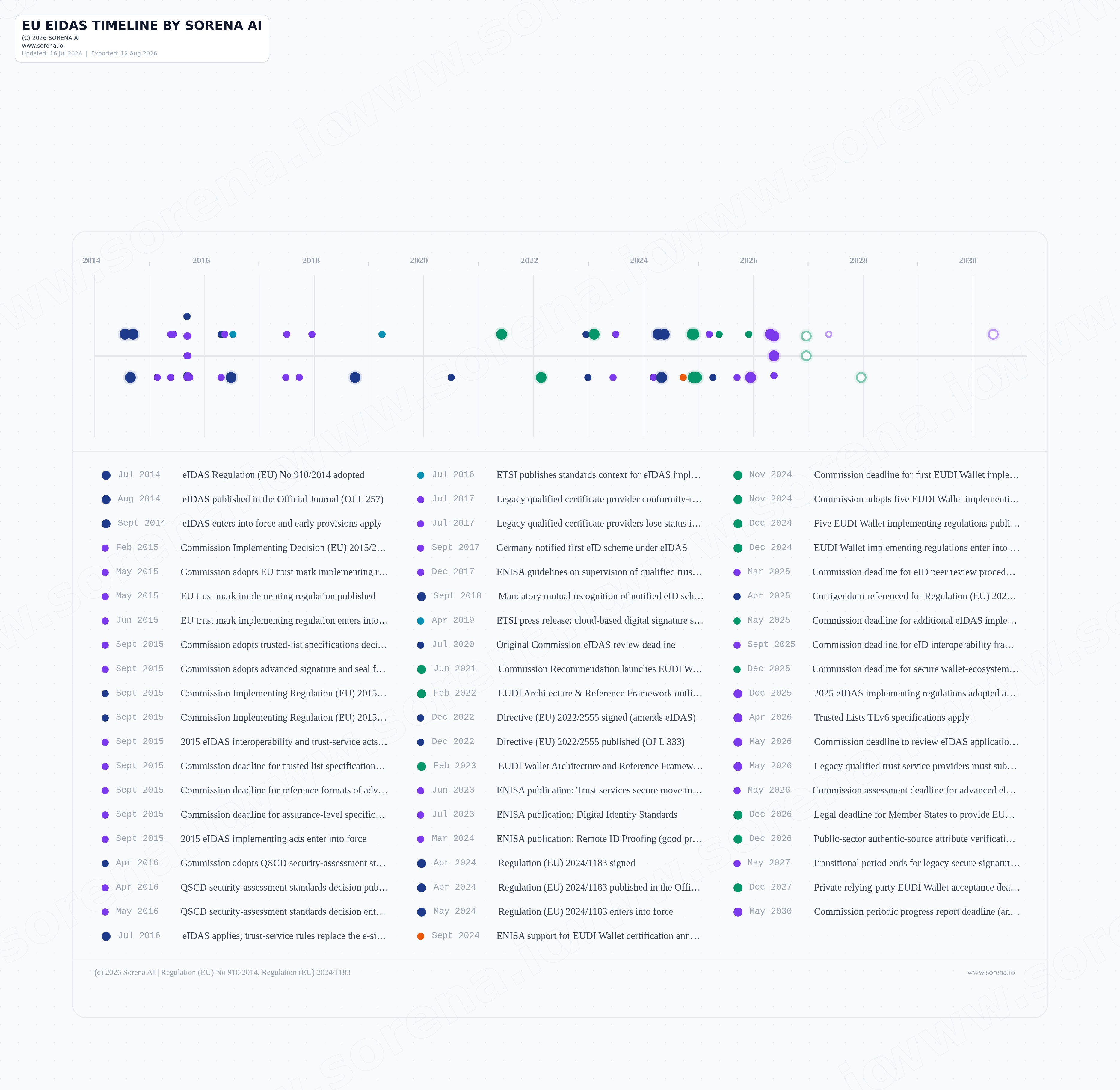
Key eIDAS dates for trust services and wallets
Track the original trust-services framework, the 20 May 2024 entry into force of the European Digital Identity Framework, implementing acts, the end-of-2026 wallet rollout, and later transition items. A timeline date does not by itself establish that a particular provider must accept a wallet; Article 5f ties private-sector acceptance to strong-authentication triggers, excludes microenterprises and small enterprises, and makes wallet use voluntary for the user.
Choose the next eIDAS decision
New to eIDAS? Start with scope, the regulated service, and your role. If those decisions are already documented, jump to legal effect, qualified status, wallet implementation, evidence, dates, or a focused comparison.
Start here: scope, roles, and the amended framework
Decide whether the facts concern notified electronic identification, an eIDAS trust service, or the EUDI Wallet ecosystem, and distinguish the original 2014 framework from the 2024 amendments.
EUDI Wallet, identity, and attribute flows
Map wallet ecosystem roles, relying-party registration and data requests, person identification data, attestations, architecture, certification dependencies, and onboarding evidence.
Trust services, signatures, and legal effect
Select the service and assurance level, then connect signatures, certificates, website authentication, remote signing, and qualified-service claims to their legal and technical evidence.
Provider status, supervision, and validation
Verify the exact qualified service, supervisory decision, conformity evidence, trusted-list status, certificate path, revocation information, and retained validation result.
Implementation, evidence, dates, and enforcement
Translate the classified role and service into owned controls, evidence packs, fixed or dependent dates, reassessment triggers, supervisory consequences, and national penalty checks.
Compare adjacent rules or answer a focused question
Separate eIDAS from privacy, cybersecurity, ETSI operational standards, and US electronic-signature law, or use the FAQ when you already know the question to resolve.
Turn eIDAS trust and wallet questions into owned work
This hub is the shared entry point for eIDAS role mapping, trust-service selection, QTSP and certificate evidence, wallet relying-party readiness, and follow-up research tied to cited sources.
- Start with the role: trust service provider, , relying party, wallet service provider, issuer, verifier, or internal product owner.
- Use Assessment Autopilot to request certificate, trusted-list, QTSP, validation, incident, privacy, and wallet-registration evidence from the right owner.
- Use Research Copilot for cited questions about qualified signatures, seals, time stamps, QWACs, electronic attestations of attributes, archiving, ledgers, and wallet relying-party obligations.
- Keep source interpretation, product requirements, security architecture, vendor evidence, and approval history attached to the same eIDAS work item.