ESPRFree Resource

EU ESPR Scope, DPP and evidence hub

Use this hub to scope products under Regulation (EU) 2024/1781, track which delegated acts could apply, and prepare the records that product-specific ESPR rules may require: ecodesign evidence, DPP identifiers, technical documentation, conformity declarations, unsold-goods disclosures and market-surveillance files.

ESPR entered into force on 18 July 2024, but it is framework legislation. Concrete product requirements are set later through delegated acts, either by product group or horizontally for products with shared characteristics. Treat DPP field lists, performance thresholds, exact product deadlines and penalties as delegated-act questions unless the current legal text or an adopted act says otherwise.

Review ESPR readiness
Publication details
Editorial metadata for this artifact
Author
Sorena AI
Published
Feb 23, 2026
Updated
May 26, 2026
ESPR questions this hub helps resolve
Scope
Check whether the item is a physical good, component, intermediate product, remanufactured product or excluded category before assigning manufacturer, importer, distributor, dealer, fulfilment-service or online-marketplace work.
Delegated acts
Track the working plan, preparatory studies, consultations and adopted delegated acts before treating a product aspect, threshold, conformity module or DPP field as binding for a product group.
DPP readiness
Plan for data carriers, product, operator and facility identifiers, access rights, back-up availability, registry connection, web portal access and customs or market-surveillance use without inventing fields before the delegated act.
By Sorena AIUpdated 2026-05Grounded in official EU and DPP standards sources
Quick scan
ESPR
Start with the legal boundary
ESPR extends ecodesign beyond energy-related products to almost all categories of physical goods, while excluding categories such as food and feed, medicinal products, living organisms and certain vehicles where sector rules apply.
Separate framework from product rules
The root regulation enables performance and information requirements. The enforceable product detail comes from delegated acts, including any applicable product aspects, conformity assessment, information requirements, DPP content and standards references.
Prepare evidence that authorities can inspect
Keep the product description, intended use, applied harmonised standards or common specifications, measurements, test reports, information-requirement outputs, technical documentation and EU declaration logic together with the DPP record.
Use the hub to keep product classification, delegated-act monitoring, DPP architecture, unsold-goods records and market-surveillance evidence in one reviewable file.
18 Jul 2024
In force
Art. 4
Delegated acts
Annex III
DPP elements
19 Jul 2026
Unsold ban starts
Portfolio scope
Delegated acts
DPP architecture
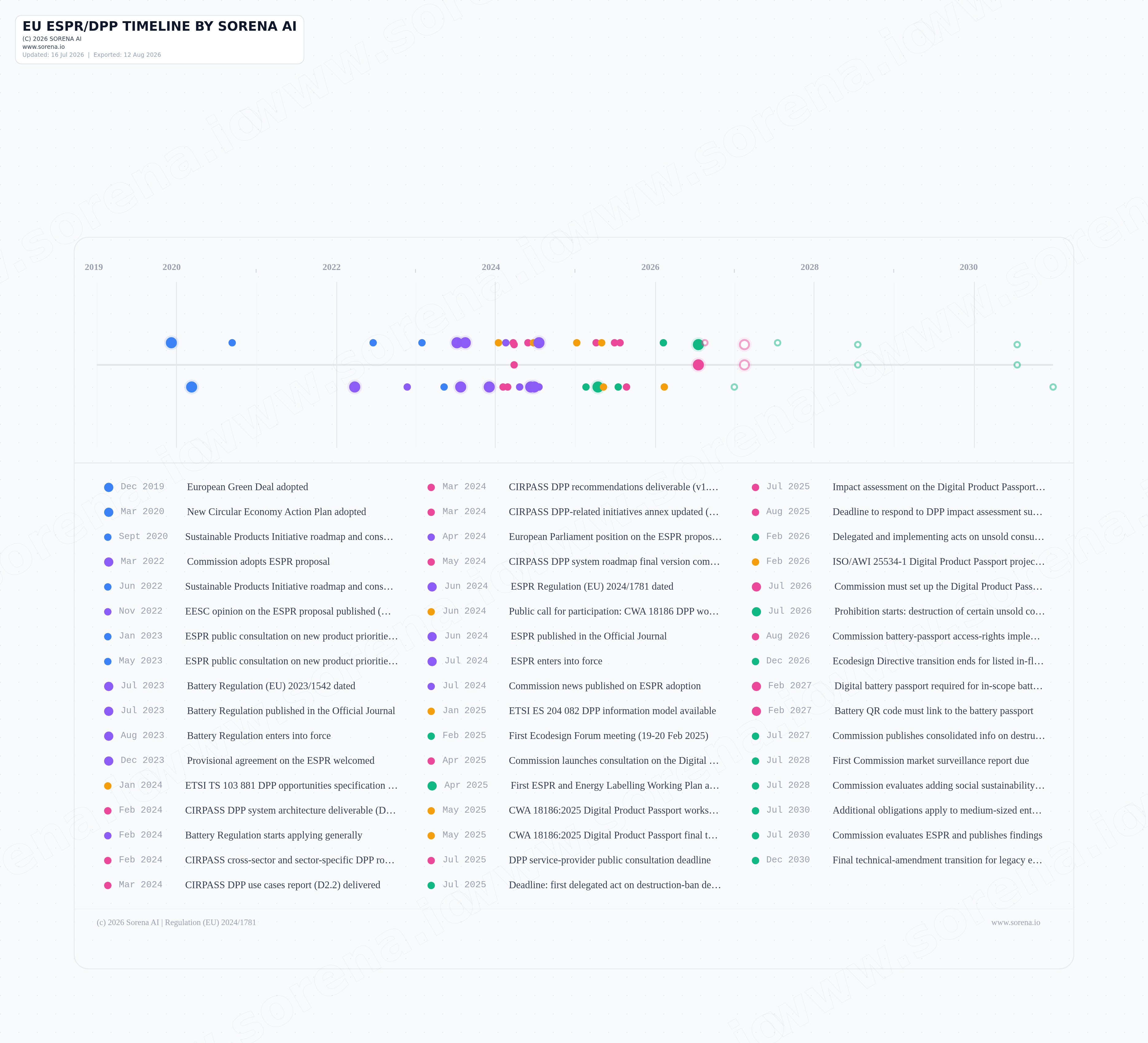
ESPR Timeline

Key milestones for ESPR + DPP

Track ESPR entry into force, working-plan updates, consultations, delegated acts, unsold-goods disclosure and destruction rules, DPP registry and portal implementation, standards or common specifications, and market-surveillance reporting without converting preliminary roadmap material into fixed product obligations.

Loading timeline...

Topic guides

Deep dive pages for implementation planning, controls, reporting, and evidence.

1
ESPR and DPP connection: delegated acts, identifiers, and access
How ESPR connects ecodesign information requirements to Digital Product Passports, including delegated acts, data carriers, identifiers, access rights, registry, and architecture choices.
Read Guide
2
ESPR Applicability Test for Products and DPP Readiness
A source-linked ESPR applicability test for physical product scope, exclusions, delegated-act dependency, economic operator triage, DPP readiness, unsold goods, and evidence.
Read Guide
3
ESPR compliance checklist for delegated acts and DPP readiness
A source-linked ESPR checklist for monitoring delegated acts, mapping product requirements, preparing technical documentation, and building DPP and unsold-goods evidence.
Read Guide
4
ESPR compliance program operating model
Build an ESPR operating model for product-group intake, delegated-act monitoring, supplier evidence, DPP governance, release gates, and authority response.
Read Guide
5
ESPR compliance: delegated acts, DPP and evidence
Practical ESPR compliance guidance for mapping product delegated acts, Digital Product Passport dependencies, unsold goods duties, technical documentation, standards, and market-surveillance evidence.
Read Guide
6
ESPR deadlines and compliance calendar
Source-linked ESPR calendar for framework dates, delegated-act dependency, working-plan monitoring, unsold-goods disclosure, and DPP readiness limits.
Read Guide
7
ESPR delegated act intake by product group
A grounded intake checklist for tracking ESPR delegated acts by product group, covering product identification, DPP data, ecodesign requirements, conformity evidence, and source limits.
Read Guide
8
ESPR delegated act intake workflow
A source-grounded intake workflow for ESPR delegated acts: trigger checks, product-group scope, requirement extraction, DPP impacts, release gates, owners, and evidence outputs.
Read Guide
9
ESPR delegated acts watchlist for product and DPP teams
Track ESPR delegated-act priorities without inventing dates: product groups, source status, likely requirement types, DPP impact, evidence owners, and open source gaps.
Read Guide
10
ESPR destruction of unsold goods: disclosure, ban scope, and records
Source-linked ESPR guide to unsold consumer product disclosure, destruction-ban scope, records, derogations, and national enforcement limits.
Read Guide
11
ESPR DPP information mapping workflow
Map ESPR delegated-act information requirements into DPP data elements, source systems, access levels, identifiers, carriers, validation evidence, and unresolved design decisions.
Read Guide
12
ESPR durability, repairability, and recyclability evidence
Build ESPR evidence for durability, repairability, and recyclability without inventing product-group tests before the applicable delegated act is known.
Read Guide
13
ESPR Ecodesign Evidence Checklist
Checklist for collecting ESPR ecodesign evidence from delegated acts, technical documentation, supplier substantiation, DPP mapping, standards, and market surveillance records.
Read Guide
14
ESPR ecodesign requirement types: performance, information, and DPP links
Source-grounded guide to ESPR ecodesign requirement types, product parameters, delegated-act dependency, DPP links, and evidence implications.
Read Guide
15
ESPR FAQ: scope, delegated acts, DPP, unsold goods
Standalone ESPR FAQ answers on product scope, delegated acts, Digital Product Passports, unsold goods, product priorities, standards, surveillance, and source limits.
Read Guide
16
ESPR harmonised standards and common specifications
How ESPR uses harmonised standards, common specifications, delegated acts, and DPP standards evidence without inventing product-specific requirements.
Read Guide
17
ESPR Information Requirements to DPP Mapping
Map ESPR information requirements into Digital Product Passport data classes, source systems, access rules, carrier choices, validation checks, and evidence records.
Read Guide
18
ESPR Information Requirements, Labels, and Disclosure
Grounded ESPR guide to delegated-act information requirements, product labels, digital product passport access, data carriers, and unsold-goods disclosure.
Read Guide
19
ESPR market surveillance technical documentation checklist
Source-grounded ESPR checklist for technical documentation, conformity evidence, DPP records, and responses to market surveillance authority requests.
Read Guide
20
ESPR penalties and fines: Member State rules and evidence
A conservative ESPR penalties guide explaining Article 74, why fine amounts depend on Member State law, and which conformity and market-surveillance evidence matters.
Read Guide
21
ESPR Product Priorities and Delegated Acts Tracker
Track ESPR priority product groups, source status, delegated-act progress, expected DPP impact, owners, evidence, and source gaps without treating preliminary studies as binding obligations.
Read Guide
22
ESPR requirements: delegated acts, ecodesign, DPP, and evidence
ESPR requirements explained as a framework for delegated acts, ecodesign performance and information rules, Digital Product Passports, unsold goods, technical documentation, and market surveillance.
Read Guide
23
ESPR unsold goods disclosure tracker
Track ESPR unsold consumer product disclosure fields, website publication evidence, destruction-ban status, owners, and unresolved source gaps.
Read Guide
24
ESPR vs Batteries Regulation Comparison
Compare ESPR delegated-act planning with the Batteries Regulation product-specific regime, including DPP overlap, battery passport evidence, timing limits, and source boundaries.
Read Guide
25
ESPR vs Ecodesign Directive
Compare ESPR with the earlier Ecodesign Directive across scope, legal form, delegated acts, DPP requirements, unsold goods, transition rules, and evidence.
Read Guide
26
ESPR vs GPSR: Sustainability vs Product Safety
A source-limited comparison of ESPR sustainability and product-information requirements against GPSR product-safety context, with evidence and DPP reuse limits.
Read Guide
27
ESPR vs PPWR Comparison
Compare ESPR product ecodesign and Digital Product Passport work with the separate PPWR packaging regime, using only source-linked ESPR and packaging-boundary claims.
Read Guide
28
ESPR vs REACH and RoHS Comparison
Compare ESPR ecodesign, sustainability, information, and digital product passport requirements with source-limited REACH and RoHS substance-control context.
Read Guide
29
Timeline for ESPR: practical implementation guide
Practical ESPR guidance for Timeline, with source-linked decisions, owners, evidence records, and implementation steps.
Read Guide
30
What ESPR is and why it matters
A grounded explainer of the EU Ecodesign for Sustainable Products Regulation, including scope, delegated acts, DPPs, unsold goods, and enforcement limits.
Read Guide
Next step

Turn ESPR scope into owned product and evidence work

Use this hub as the shared entry point for legal, product, sustainability, supply-chain, engineering, ecommerce and compliance teams. Confirm whether a delegated act applies before assigning binding product requirements, and keep DPP architecture separate from unapproved product-field assumptions.

What this unlocks
  • Start with one product family, placing-on-the-market path, operator role, current ecodesign rule, draft or adopted delegated act, and DPP dependency.
  • Use ESG Compliance to assign delegated-act monitoring, supplier data collection, unsold-goods disclosure, product-priority review, DPP readiness and public-procurement criteria tracking.
  • Use SSOT to keep product classifications, technical documentation, standards decisions, measurements, test reports, conformity declarations, DPP identifiers, registry evidence and market-surveillance responses together.
  • Escalate product-group dates, DPP fields, penalties, exemptions and conformity-assessment routes against the current legal text or adopted delegated acts before release planning.
EU ESPR artifact preview
Share it internally
Download the timeline export to align legal, product, engineering, and commercial teams on milestones and deadlines.