Singapore PDPAFree Resource

Singapore PDPA Compliance Overview

Start with the processing activity, not a company-wide label: identify the , statutory boundary, organisation or data-intermediary role, purpose and consent route, then assign the lifecycle, breach, marketing, and transfer controls that follow.

By Sorena AIBased on PDPC and Singapore Statutes Online sourcesNo signup required
Quick scan
PDPA
Accountability baseline
Keep the record, evidence that the relevant business contact information is available to the public, data protection policies, complaint process, staff communications, and evidence that policies are implemented.
Data intermediary model
A processes on behalf of another organisation under a written or evidenced contract. Its direct PDPA duties for that processing cover protection, retention limitation, and breach notice to the engaging organisation or public agency without undue delay; the engaging organisation remains responsible for the wider obligation set.
Breach readiness
Take reasonable and expeditious steps to assess suspected breaches. guidance says to complete the assessment within 30 calendar days; the statutory PDPC notification clock is no later than 3 calendar days after determining that the breach is notifiable.

This hub helps align legal, security, marketing, vendor management, and operations on the same Singapore PDPA evidence set.

Key dates
PDPC
Regulator
DPO
Public contact
30d
PDPC guide
3d
Notify
What this hub helps you check
Scope and role
Confirm whether the activity involves about an identifiable individual and a Singapore processing activity, whether an actor or data boundary applies, and whether each party acts as an organisation or for that specific processing. The PDPA covers electronic and non-electronic records; inaccurate or inferred data can still be personal data.
Accountability and consent
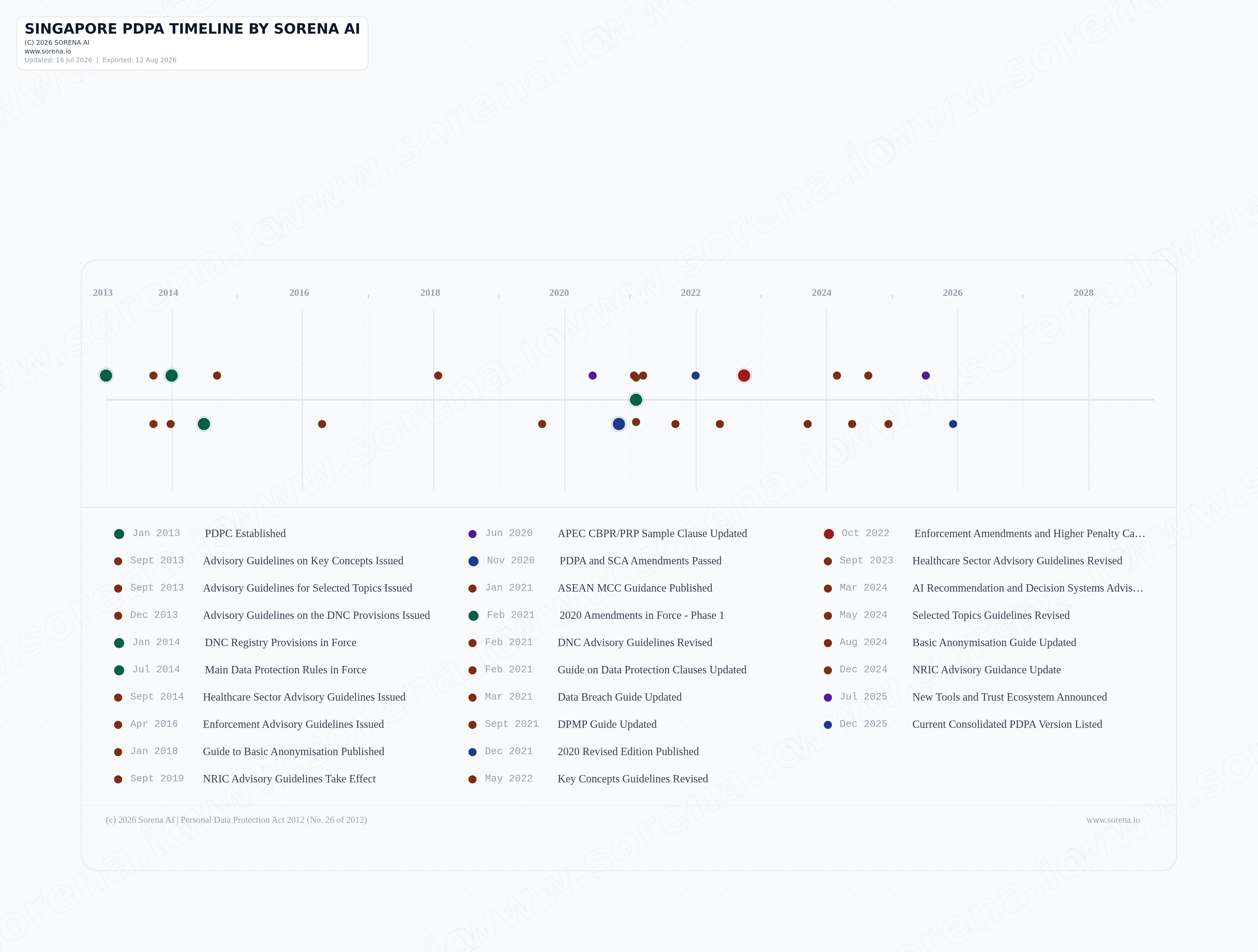
Document designation, business contact information made available to the public, collection-use-disclosure purposes, consent or deemed-consent basis, notification text, complaints process, staff training, and policy access. The main data protection rules took effect on 2 July 2014, and the 2020 amendments took effect in phases from 1 February 2021. Treat data portability as under development, not an active transfer-on-request duty, unless a later commencement source applies.
Breach, DNC, and transfers
Prepare breach assessment records, vendor breach escalation, checking evidence, marketing-consent proof, and overseas-transfer safeguards such as comparable-protection clauses or recognised certifications.
Scope and roles
Breach records
DNC and transfers
Publication details
Editorial metadata for this artifact
Author
Sorena AI
Published
Feb 21, 2026
Updated
Jul 31, 2026

The PDPA applies to activities involving in Singapore, including relevant activities by overseas organisations. The same business can be the accountable organisation for its own processing and a when it processes personal data on behalf of and for another organisation's purposes under a written or evidenced contract.

Focused Singapore PDPA guidance

Choose the rule for the activity

Start with the guide that matches the processing, marketing, incident, enforcement, or transfer decision under Singapore's Protection Act (PDPA). The complete guide library follows below.

Choose a deemed-consent route

Deemed consent allows specified processing without express consent when the PDPA's conditions are met. Separate consent inferred from conduct, processing needed for a contract, deemed consent by notification, and the legitimate-interests exception. For notification or legitimate interests, document the assessment, reasonable steps, notice, opt-out where required, safeguards, and approval.

Compare the consent routes
Check DNC marketing messages

The Do Not Call (DNC) Registry lets people register Singapore telephone numbers against marketing calls, texts, or faxes. Decide whether the message advertises or promotes goods, services, interests, suppliers, or business opportunities and therefore counts as a specified message. Then record the DNC check, clear consent, or applicable exclusion.

Review the DNC rules

Assess a data breach

A breach is notifiable when it is likely to cause or affects at least 500 people, which is . The Protection Commission () recommends completing the initial assessment within 30 calendar days. Once the organization determines that notification is required, the statutory three-calendar-day notification clock starts.

Open the breach playbook

Plan an overseas transfer

An overseas transfer sends or makes accessible outside Singapore. Before the transfer, choose a permitted route and ensure the recipient provides protection comparable to the PDPA, commonly through enforceable contractual duties. Record the destination, purpose, data, recipient checks, safeguards, onward-transfer limits, and ongoing oversight.

Review transfer safeguards

Understand PDPA penalties

The can issue directions, accept enforceable undertakings, and impose financial penalties after considering the facts of the contravention. Estimate exposure from the legal maximum, the organization's turnover where relevant, the harm, duration, intent, mitigation, cooperation, and prior conduct. One headline amount does not predict the penalty in another case.

Review penalties and enforcement
PDPA Overview

Operational checkpoints for Singapore PDPA

Use the hub to connect PDPA scope, accountability, breach notification, , , and transfer checks to evidence records.

Loading timeline...
Recommended reading path

Choose the next Singapore PDPA decision

New to the PDPA? Start with the activity-level applicability and role tests. If those decisions are already documented, jump to the consent route, vendor or transfer control, incident clock, marketing check, or evidence tool you need.

1

Start here: scope, roles, and core duties

Establish what personal data and activity are in scope, test the exclusions, classify each party as an organisation or data intermediary for that activity, and map the obligations that follow.

2

Choose and document the collection, use, or disclosure basis; build the accountability programme; and apply the specific controls for notices, NRIC data, anonymisation, and impact assessment.

Singapore PDPA Consent, Notification and Purpose Rules
How Singapore PDPA consent, notification, purpose limitation, deemed consent, withdrawal, and consent exceptions should be handled in product and privacy workflows.
Read guide
Singapore PDPA Deemed Consent and Legitimate Interests
How to apply Singapore PDPA deemed consent by conduct, contractual necessity, notification, and legitimate interests with opt-out, adverse-effect, disclosure, and assessment records.
Read guide
Singapore PDPA Consent and Deemed Consent Workflow
Choose express consent, deemed consent by conduct, contractual necessity, notification, or the legitimate interests exception under Singapore PDPA with fact-based intake fields and evidence records.
Read guide
Singapore PDPA DPMP Accountability Guide
Build a Singapore PDPA Data Protection Management Programme with DPO ownership, policies, data inventories, DPIAs, training, monitoring, breach logs, and review records.
Read guide
Singapore PDPA Privacy Policy Template
A Singapore PDPA privacy policy template for writing notices, DPO contact details, access and correction routes, retention, transfers, protection, withdrawal, and complaint handling without overclaiming compliance.
Read guide
Singapore PDPA Anonymisation and DPIA Records
Build Singapore PDPA anonymisation and DPIA records around PDPC guidance: release model, re-identification risk, data flows, action plans, safeguards, and monitoring.
Read guide
Singapore PDPA NRIC Handling Rules
When Singapore organisations may collect, use, disclose, retain, mask, or replace NRIC numbers, including the 31 December 2026 authentication deadline.
Read guide
3

Vendors, data intermediaries, and overseas transfers

Allocate organisation and intermediary duties per processing activity, contract for instructions and breach escalation, and prove comparable protection before personal data leaves Singapore.

4

Breach clocks, evidence, and enforcement

Separate the significant-harm and significant-scale tests, open the assessment record promptly, apply the post-determination notification clock, and understand how PDPC directions and financial penalties work.

5

DNC marketing, implementation tools, and questions

Classify specified messages to Singapore telephone numbers, preserve DNC or consent evidence, use the implementation checklist, compare the PDPA with the GDPR, or go directly to a focused answer.

Next step

Turn Singapore PDPA requirements into owned evidence records

This hub is the intake point for PDPA implementation work: identify the processing activity, assign the right owner, connect the obligation to an official source, and keep the record that proves the control is operating.

What this unlocks
  • Start with a product, vendor, campaign, breach, transfer, or data collection activity and identify the PDPA scope and role before assigning work.
  • Use Assessment Autopilot to request designation and public-contact evidence, consent and notification records, vendor clauses, breach assessment logs, DNC checking files, and transfer safeguards.
  • Use Research Copilot for cited questions about business contact information, deemed consent, duties, notifiable breach thresholds, DNC exceptions, or overseas transfer routes.
  • Keep legal interpretation, operational controls, and evidence requests connected to guidance and Singapore Statutes Online sources.
Singapore PDPA artifact preview
Share it internally
Download the timeline export to align legal, product, engineering, and commercial teams on milestones and deadlines.