One model gives you one set of failure modes
Ask a single large language model whether a control satisfies an obligation and it will answer fluently, in a paragraph that reads like someone checked. Often nobody did.
Unsupported, incomplete, and wrong answers can arrive in the same tone as correct ones. NIST calls this confabulation: confidently stated but erroneous or false content, often called hallucination or fabrication, that can mislead users. Relying on one model gives you one failure mode and no independent challenge. Its confidence is not evidence.
Fluent answers still need source checks
In casual use, a guess may be harmless. You reread the email, sanity-check the summary, and move on. In GRC, the wrong interpretation of a clause, control mapping, or applicability call can show up in an audit, a filing, or a customer questionnaire that carries your name.
A single model gives you weak visibility into whether an answer is supported or merely polished. You still have to verify the source, citation, and reasoning before relying on it. Stanford HAI found that even legal AI research tools produced incorrect information in benchmarking queries, so compliance answers need source checks.
Independent agents catch each other's mistakes
Query several models independently and compare their outputs. Idiosyncratic errors, the ones one model makes and another does not, are easier to surface through cross-verification. Another model may challenge the source, the interpretation, or missing evidence.
Multi-agent consensus and self-consistency use this approach: generate several answers and compare them instead of trusting the first fluent paragraph. Agreement is not proof, but disagreement tells you where a human should look. The panel exposes conflicts rather than merely voting.
Make disagreement visible
Use multi-agent review to expose uncertainty. One agent finds the source. Another checks whether the source supports the claim. Another looks for conflicting obligations. When they disagree, the workflow should show the conflict and ask for human judgment.
Consensus can increase confidence, but the evidence still lives in the cited sources and the reviewer's decision.
Benchmark results show gains and tradeoffs
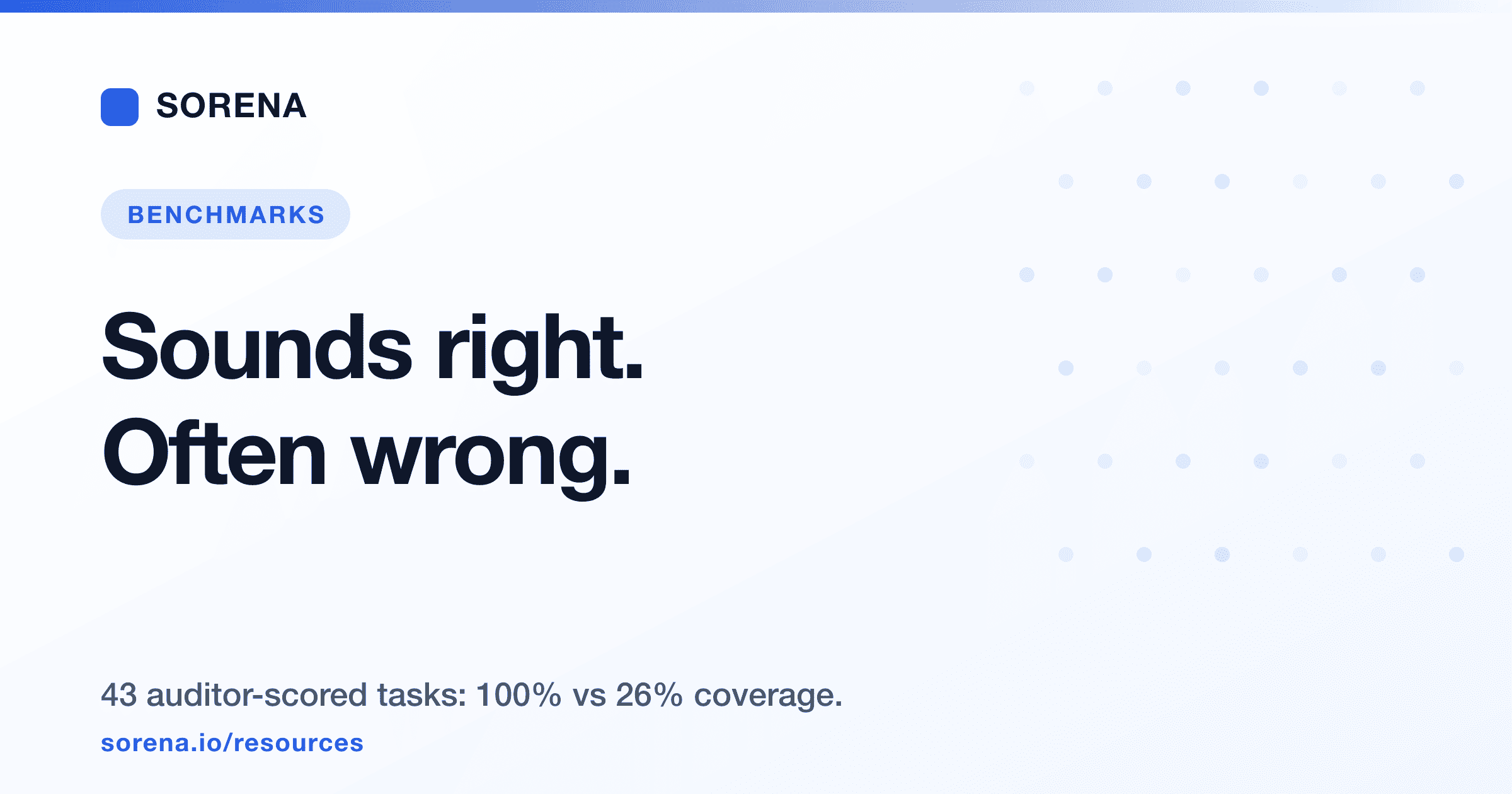
A 2026 Frontiers in Artificial Intelligence study compared a deterministic multi-agent orchestrator with single-model baselines on a 300-question MMLU subset. ORCH reached 81.3% accuracy, compared with 76.7% for the strongest single-model baseline and 73.0% for DeepSeek-chat. The 4.6-point advantage over the strongest baseline did not reach the conventional 5% significance threshold in that test (p = 0.088).
The study tested general reasoning, not compliance correctness. An arXiv study of a different multi-agent system also reported lower hallucination rates on HaluEval than its individual-model baselines. These results support domain-specific evaluation, not a guarantee that adding agents will improve every task. Multiple calls also add cost and latency.
How Sorena turns models into a panel
The Sorena AI Assistant sends the same question to specialized agents and surfaces where they agree, diverge, and what each answer rests on. The result includes visible disagreements instead of presenting one model's output as settled.
For deeper work, the Sorena Research Copilot applies the same discipline to regulatory questions. It assembles findings, cites the supporting passages, and flags thin evidence. Humans decide; systems execute.
Keep the final decision with an accountable person
A panel of agents gives human judgment better inputs. The system narrows the question, surfaces disagreements, and cites sources. The accountable person makes the call.
Consensus can reduce the odds of an idiosyncratic blind spot, but it cannot certify that an answer is correct or compliant. An ISO/IEC 42001 operating model should define roles, oversight, evaluation, evidence, and review triggers rather than use the model as the control. A panel can stress-test an answer and show reviewers where it was weakest.
Show disagreement and keep the human decision
Run independent reviews where the cost of a wrong answer warrants the extra time and compute. Show the sources and disagreements, then route the final judgment to an accountable person.
Frequently asked questions
Does running multiple agents add cost and latency?+
Yes. Multiple model calls cost more and take longer than one call. Use them where the value of independent review warrants the trade, and validate the workflow on the compliance tasks it will handle.
Does agreement between agents guarantee the answer is correct?+
No. Consensus can surface disagreement and some idiosyncratic errors, but models can share the same blind spot. A human with accountability still makes the final decision, and every answer must stay traceable to its source.
Can this replace expert or legal review?+
No. This is not legal advice and a panel of agents is not a substitute for qualified counsel or a compliance professional. The system narrows the question, cites the evidence, and flags disagreement so the human decision is better informed. The judgment, and the accountability, remain with your people.
Sources
- ORCH: a deterministic multi-agent orchestrator for discrete-choice reasoning (Frontiers in Artificial Intelligence, 2026)https://www.frontiersin.org/journals/artificial-intelligence/articles/10.3389/frai.2026.1748735/full?ref=sorena.io
- Council Mode: A Heterogeneous Multi-Agent Consensus Framework for Reducing LLM Hallucination and Bias (arXiv)https://arxiv.org/abs/2604.02923?ref=sorena.io
- AI on Trial: Legal Models Hallucinate in 1 out of 6 or More Benchmarking Queries (Stanford HAI)https://hai.stanford.edu/news/ai-trial-legal-models-hallucinate-1-out-6-or-more-benchmarking-queries?ref=sorena.io
- NIST AI 600-1, Artificial Intelligence Risk Management Framework: Generative Artificial Intelligence Profilehttps://nvlpubs.nist.gov/nistpubs/ai/NIST.AI.600-1.pdf?ref=sorena.io