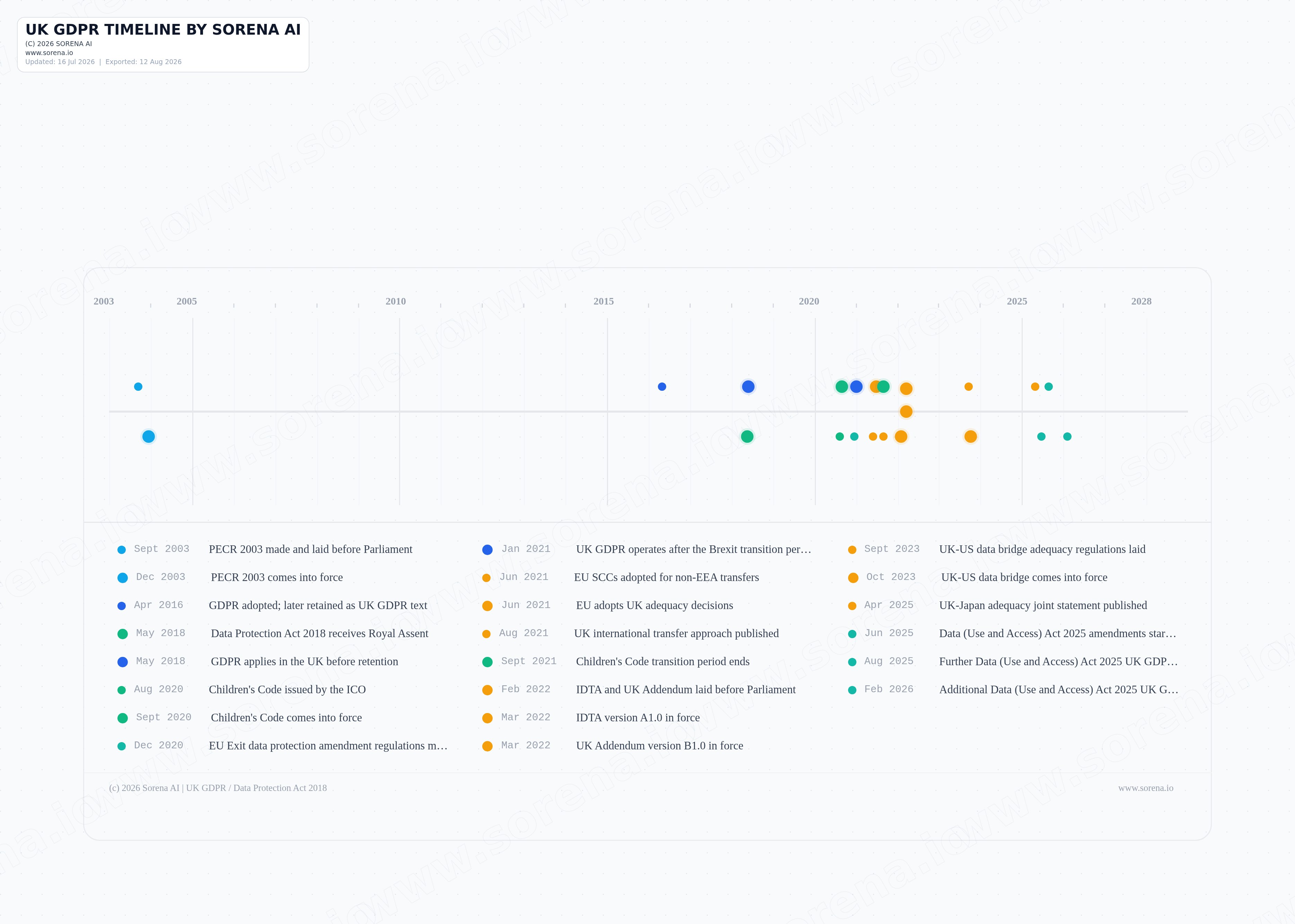
UK GDPR Timeline and Implementation Guide
UK GDPR is the UK's main ruleset for processing . It works with the Data Protection Act 2018, which supplements the regime with conditions, exemptions, enforcement powers, and separate rules for law-enforcement and intelligence processing.
Follow the recommended path from scope and roles to lawful processing, rights, evidence, incidents, transfers, and UK-specific changes.
Start with one processing activity: confirm Article 2 material scope and Article 3 territorial scope, identify and roles, choose the Article 6 basis and any Article 9 or 10 condition, then connect transparency, rights, accountability, security, breach, transfer, and sector-specific duties. The consolidated text includes the Data (Use and Access) Act 2025 changes brought fully into force for these topics on 5 February 2026, including Articles 22A-22D, Articles 44A-45C, and the children's higher-protection matters in Article 25.
Key milestones for UK data protection operations
The chronology separates the original EU GDPR application, the UK's post-transition regime, transfer instruments, and later amendments. For operations, confirm scope and roles; document lawful basis and any special-category condition; run rights requests under the amended Article 12 and 12A timing rules; assess breaches against the separate ICO and individual-notice thresholds; and document the applicable Chapter V transfer route. Timeline dates are legal or policy milestones, not recurring internal review deadlines.
Choose the next UK GDPR decision
Start with a specific processing activity, scope, roles, and lawful basis. Then move to the rights, accountability evidence, risk, incident, transfer, deadline, or comparison that the facts trigger.
Start here: scope, roles, and lawful processing
Determine whether UK GDPR applies, how it interacts with the Data Protection Act 2018, who decides purposes and means, and which lawful basis and additional data condition apply.
Transparency, rights, children, and automated decisions
Design understandable information and request handling, then apply the additional safeguards for children and significant automated decisions under the amended UK rules.
Accountability, risk, and operating evidence
Translate legal decisions into owned controls, records, assessments, contracts, security measures, and repeatable evidence rather than treating a checklist as proof of compliance.
Breaches, deadlines, and enforcement
Separate incident containment from the Article 33 ICO threshold, the Article 34 individual-notice threshold, operating clocks, and possible ICO remedies or fines.
International transfers and adequacy
Decide whether a restricted transfer exists, whether adequacy covers it, and when the IDTA, UK Addendum, risk assessment, or a narrow exception is needed.
Compare regimes or answer a focused question
Use comparisons to identify parallel UK and EU workstreams, not equivalence, and use the FAQ when you already know the question to resolve.
Turn the UK GDPR scope decision into owned evidence
Choose one processing activity and record its scope, organisational roles, lawful basis, additional data conditions, rights, security, breach, and transfer decisions before assigning the resulting controls.
- Name the legal entity, or role, purpose, systems, data categories, people, recipients, countries, and accountable owner.
- Record the Article 2 and 3 scope analysis, Article 6 basis, any Article 9 or 10 condition, and the source text used for each conclusion.
- Link notices, terms, Article 30 records, DPIAs, rights logs, breach decisions, security evidence, and transfer records to the activity.
- Reassess when the purpose, data, decision logic, users, supplier, recipient, country, retention period, or legal source changes.