EU Digital Product Passport Scope and Readiness Guide
This hub explains the framework in the Ecodesign for Sustainable Products Regulation (ESPR), Regulation (EU) 2024/1781. A product does not receive a universal DPP duty merely because ESPR is in force: start with the product group and the applicable delegated act.
Use the timeline and topic guides to turn DPP readiness into product data governance: identifiers, carrier placement, data model, registry upload, service-provider controls, access rules and evidence ownership.
Use the guides to identify the responsible , then map the delegated act's passport level (model, batch, or item), Annex III data, carrier, access rights, update roles, availability period, registry steps, and evidence.
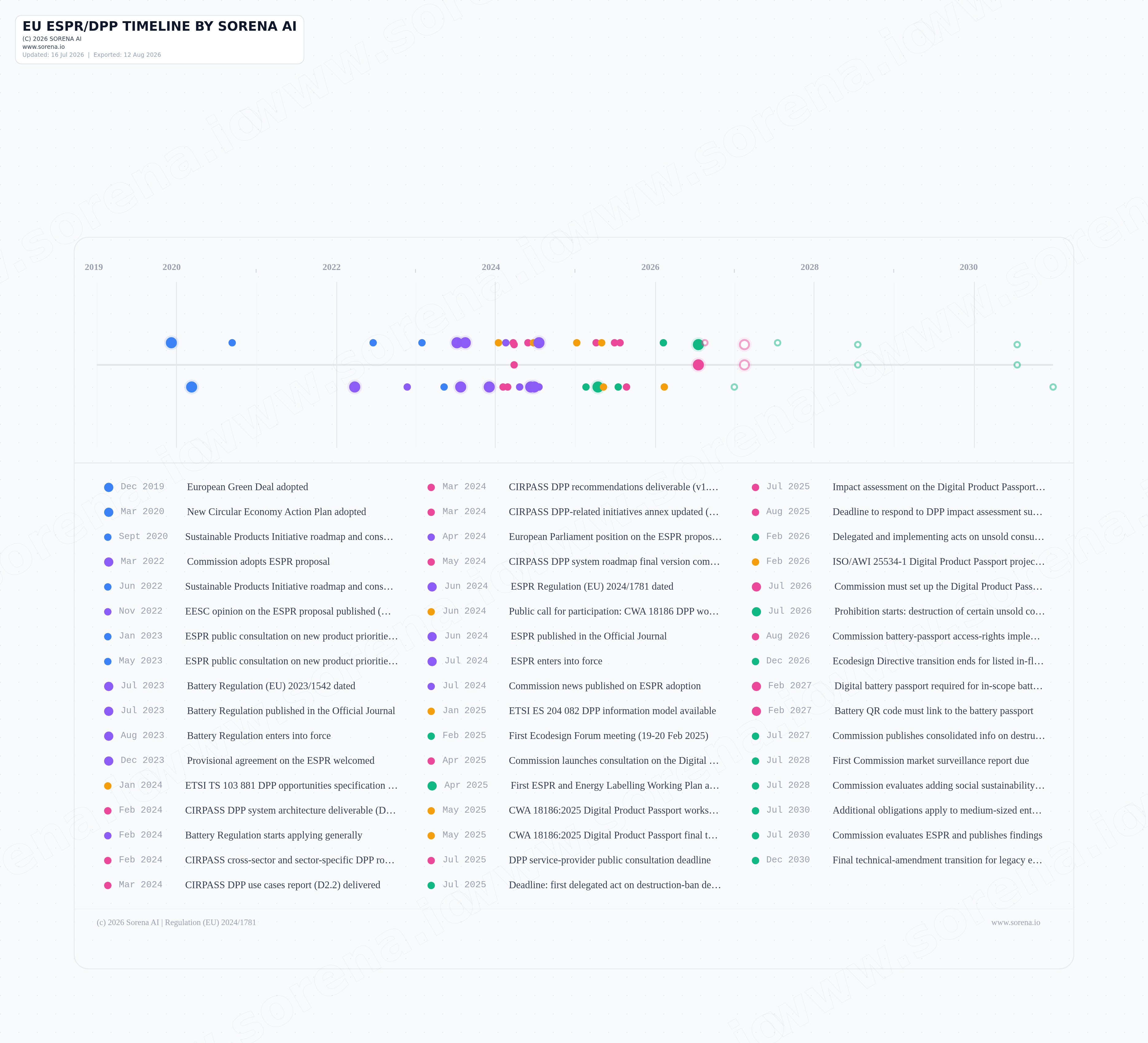
Key milestones for Digital Product Passport readiness
Use the milestone view to coordinate delegated-act monitoring, product-data modelling, supplier evidence, data-carrier decisions, registry integration, portal access, service-provider controls and customs-readiness work.
Choose the next DPP decision
New to DPP? Establish the product-group trigger and responsible operator first. If those decisions are documented, jump to the data model, architecture, implementation evidence, deadline, comparison, or focused question you need.
Start here: meaning, scope, and timing
Understand what an ESPR DPP is, test whether a product-specific rule creates a passport duty, and separate fixed legal dates from delegated-act-dependent product deadlines.
Requirements, data, and access
Translate Articles 9 to 15, Annex III, and the applicable delegated act into product fields, access categories, authority handoffs, and enforcement exposure.
Architecture, identifiers, and carriers
Design the passport as a connected system: product identity, physical carrier, resolver, role-based views, decentralised data, backup service, EU registry, and public portal each perform a different function.
Implementation, governance, and evidence
Turn the legal design into owned data intake, supplier validation, access governance, customs review, release gates, audit records, and vendor requirements.
Compare systems or answer a focused question
Separate ESPR duties from battery-passport rules, EPREL, GS1 Digital Link, digital twins, and legacy product records, or use the FAQ for a direct answer.
Turn DPP readiness into owned product-data work
This DPP hub is the shared entry point for product, regulatory, engineering, supplier, sustainability and trade teams. Route confirmed duties into ESG Compliance and keep the supporting data model, identifier records, registry evidence and access-control decisions in SSOT.
- Start with product group, delegated-act status, placing-on-the-market path, role and whether the passport is expected at model, batch or item level.
- Use ESG Compliance to assign product-data, supplier-evidence, data-carrier, registry, portal, access-rights and customs-readiness tasks to accountable owners.
- Use SSOT to keep Annex III field mapping, unique product/operator/facility identifiers, commodity codes, backup-hosting records, update permissions and evidence exports together.
- Escalate unresolved delegated-act, service-provider certification, public-versus-restricted access and customs-interconnection questions before release planning.