China Cybersecurity Law Compliance Guide
Start with the specific network, system, service, app, product, procurement, or data activity in China. Then identify the legal entity acting as , provider, data processor, platform operator, app sponsor, or purchaser under each controlling instrument.
Recommended order: scope the activity and role, classify the system and data, screen special review or filing routes, implement controls, then schedule recurring and change-triggered work.
The Cybersecurity Law applies to constructing, operating, maintaining, and using networks in China. It first took effect on 1 June 2017; amendments adopted on 28 October 2025 took effect on 1 January 2026 and renumbered the operating duties. Critical information infrastructure () status depends on identification and notice by the responsible sector protection department. Important-data status depends on the applicable national, regional, departmental, industry, or sector catalogue or an authority identification. Neither status follows automatically from being a . The review measures, app rules, filing notice, and recommended standards have separate actors and triggers.
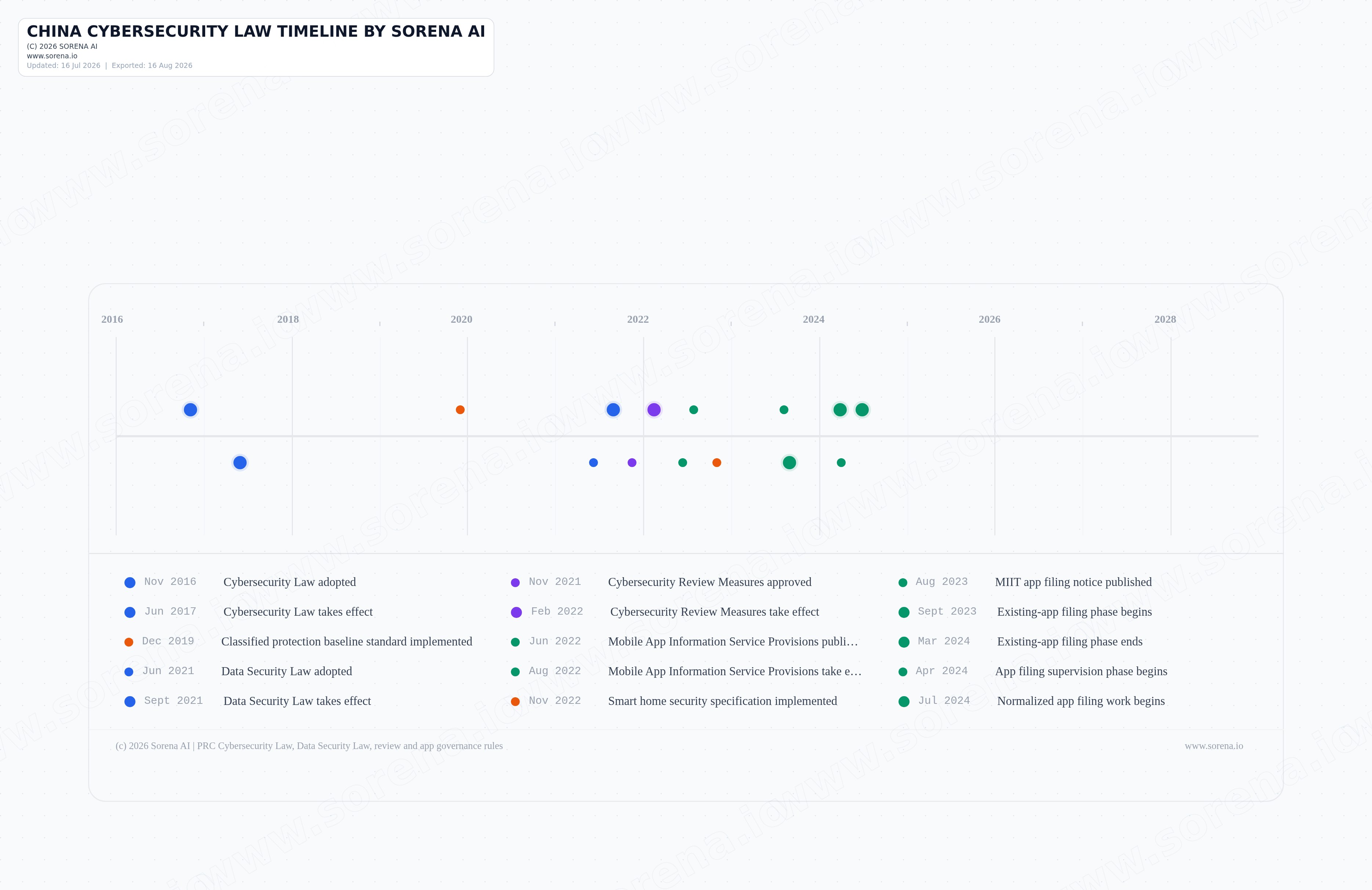
Key dates for China Cybersecurity Law
Separate law and measure effective dates from app-filing implementation phases and recommended-standard implementation dates. A historical effective date is not a new annual deadline.
Choose the next China cybersecurity decision
New to the regime? Start by scoping the activity and regulated role. If those facts are already documented, move directly to review triggers, evidence, deadlines, enforcement, or a focused comparison.
Start here: scope, roles, and baseline duties
Identify the specific China network, data activity, app, platform, procurement, or connected product before assigning duties. CII status requires sector recognition and operator notice; network-operator status alone is not enough.
Classification, review, and evidence
Classify systems and data, then document whether classified protection or cybersecurity review is relevant and what evidence supports the conclusion.
Apps and connected products
Keep app-provider, app-distribution-platform, MIIT filing, the smart-home standard, and the voluntary cybersecurity label scheme separate while linking shared product and security facts.
Deadlines and enforcement
Distinguish one-time historical effective dates from filing phases, event-driven deadlines, recurring controls, and actor-specific enforcement exposure.
Compare routes or answer a specific question
Use a comparison when one launch crosses legal regimes, or go to the focused FAQ when the immediate trigger is already known.
Build the China network security evidence file
Sorena AI helps map official China Cybersecurity Law requirements to scoped decisions, evidence records, owners, and change-triggered reviews.
- Start with the official trigger and the product, app, data flow, equipment, supplier, or lifecycle role that creates the China Cybersecurity Law question.
- Research Copilot keeps the official citation, decision owner, evidence record, and approval history connected.
- SSOT preserves official citations, launch facts, evidence files, and refresh history when product, supplier, app, data, equipment, or disposal facts change.